Millions of young lives at risk due to humanitarian funding shortfall: UNICEF
New York: “Substantial” shortfalls in humanitarian funding are placing the lives of millions of children in areas affected by conflict and disaster at risk, the UN Children’s Fund (UNICEF) warned on Tuesday.
With 2019 almost over, the agency reported that it has still only received just over half of the $4 billion it needs this year, to provide life-saving health, education, nutrition and protection programmes for 41 million children in nearly 60 countries worldwide.
Lack of funding leaves millions of children in conflict and disaster zones at risk
“Millions of vulnerable children around the world are suffering the grievous consequences of increasingly complex humanitarian crises”, said UNICEF Executive Director Henrietta Fore.
“Without additional resources, these children will not go to school, be vaccinated, receive adequate nutrition, or be protected from violence and abuse. While we continue to appeal for an end to conflicts and better readiness to emergencies, we need additional donor support to help us meet children’s most basic needs.”
Emergencies in Pakistan, Cameroon, Burkina Faso and Venezuela currently have the largest funding gaps, but the agency’s ability to respond in Syria and neighbouring countries - as well as in Yemen, the Democratic Republic of the Congo (DRC) and Bangladesh - also remains significantly underfunded.
UNICEF said the consequences will be “dire” if the shortfalls persist through the end of the year.
For example, the agency requires $61 million to provide essential services in communities in the DRC that have long suffered from humanitarian and security crises.
At the same time, these areas are currently facing an Ebola outbreak and UNICEF is working to create an environment that is conducive to effectively respond to the disease.
Meanwhile, as war continues across many parts of Syria, 460,000 child refugees could miss out on education due to a $249 million funding gap for UNICEF programmes in Turkey, Lebanon, Jordan, Iraq and Egypt.Ms. Fore, the UNICEF Executive Director, appealed for a surge in support: “During my time on the ground in countries under crisis – countries like DRC, Mozambique, South Sudan, Syria and Yemen – I’ve seen firsthand the power of humanitarian funding to change the lives of vulnerable children for the better,” she said.
“With increased support, together we can reach even more of the children who need us most.”
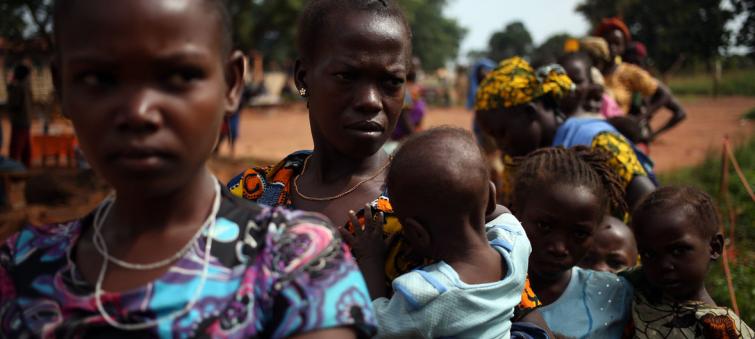
Photo caption and credit:
UNICEF/Bindra
Women who fled violence and in the Central African Republic queue with their children to receive treatment at a UNICEF-supported clinic.
Support Our Journalism
We cannot do without you.. your contribution supports unbiased journalism
IBNS is not driven by any ism- not wokeism, not racism, not skewed secularism, not hyper right-wing or left liberal ideals, nor by any hardline religious beliefs or hyper nationalism. We want to serve you good old objective news, as they are. We do not judge or preach. We let people decide for themselves. We only try to present factual and well-sourced news.
Support objective journalism for a small contribution.