 Nobel Prize
Joel Mokyr, Philippe Aghion and Peter Howitt awarded Nobel Prize for Economics
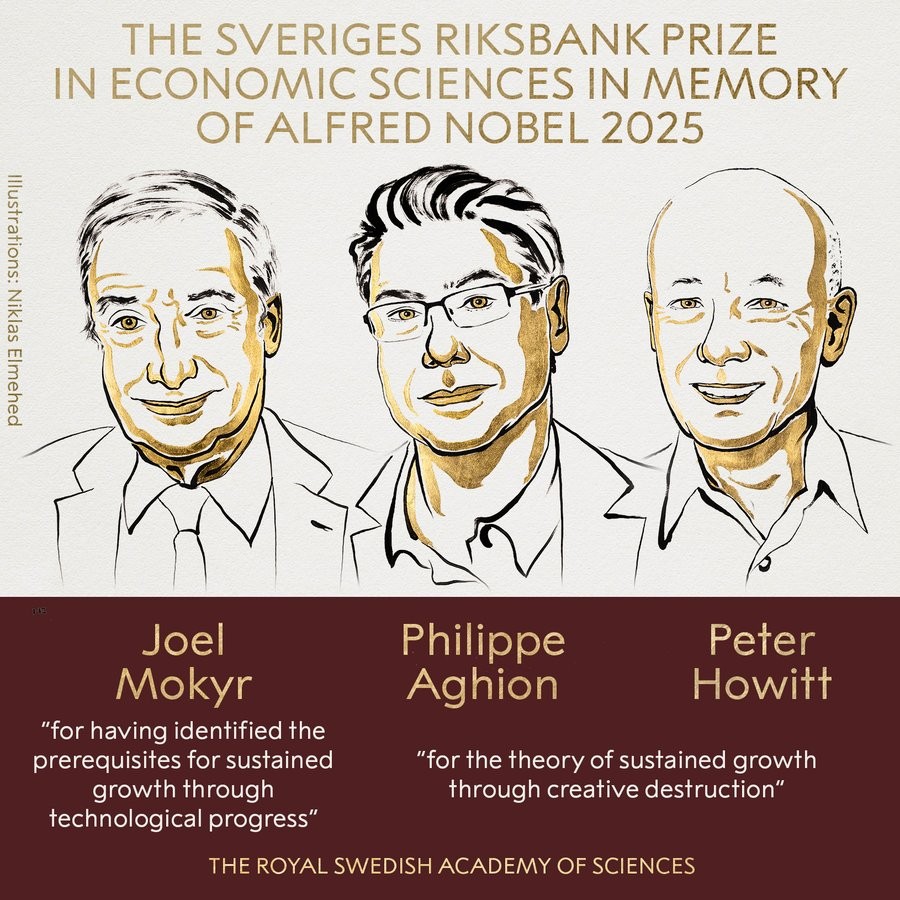
The Nobel Prize committee on Monday awarded the economics award to Joel Mokyr, Philippe Aghion and Peter Howitt for "having explained innovation-driven economic growth".
In a statement, the committee said this year’s laureates in economic sciences, Joel Mokyr, Philippe Aghion and Peter Howitt, explain how innovation provides the impetus for further progress.
Technology advances rapidly and affects us all, with new products and production methods replacing old ones in a never-ending cycle. This is the basis for sustained economic growth, which results in a better standard of living, health and quality of life for people around the globe.
However, this was not always the case. Quite the opposite – stagnation was the norm throughout most of human history. Despite important discoveries now and again, which sometimes led to improved living conditions and higher incomes, growth always eventually levelled off.
Joel Mokyr used historical sources as one means to uncover the causes of sustained growth becoming the new normal. He demonstrated that if innovations are to succeed one another in a self-generating process, we not only need to know that something works, but we also need to have scientific explanations for why. The latter was often lacking prior to the industrial revolution, which made it difficult to build upon new discoveries and inventions. He also emphasised the importance of society being open to new ideas and allowing change.
Philippe Aghion and Peter Howitt also studied the mechanisms behind sustained growth. In an article from 1992, they constructed a mathematical model for what is called creative destruction: when a new and better product enters the market, the companies selling the older products lose out. The innovation represents something new and is thus creative. However, it is also destructive, as the company whose technology becomes passé is outcompeted.
In different ways, the laureates show how creative destruction creates conflicts that must be managed in a constructive manner. Otherwise, innovation will be blocked by established companies and interest groups that risk being put at a disadvantage.
“The laureates’ work shows that economic growth cannot be taken for granted. We must uphold the mechanisms that underly creative destruction, so that we do not fall back into stagnation,” says John Hassler, Chair of the Committee for the prize in economic sciences.
BREAKING NEWS
— The Nobel Prize (@NobelPrize) October 13, 2025
The Royal Swedish Academy of Sciences has decided to award the 2025 Sveriges Riksbank Prize in Economic Sciences in Memory of Alfred Nobel to Joel Mokyr, Philippe Aghion and Peter Howitt “for having explained innovation-driven economic growth” with one half to Mokyr… pic.twitter.com/ZRKq0Nz4g7
Support Our Journalism
We cannot do without you.. your contribution supports unbiased journalism
IBNS is not driven by any ism- not wokeism, not racism, not skewed secularism, not hyper right-wing or left liberal ideals, nor by any hardline religious beliefs or hyper nationalism. We want to serve you good old objective news, as they are. We do not judge or preach. We let people decide for themselves. We only try to present factual and well-sourced news.
Support objective journalism for a small contribution.