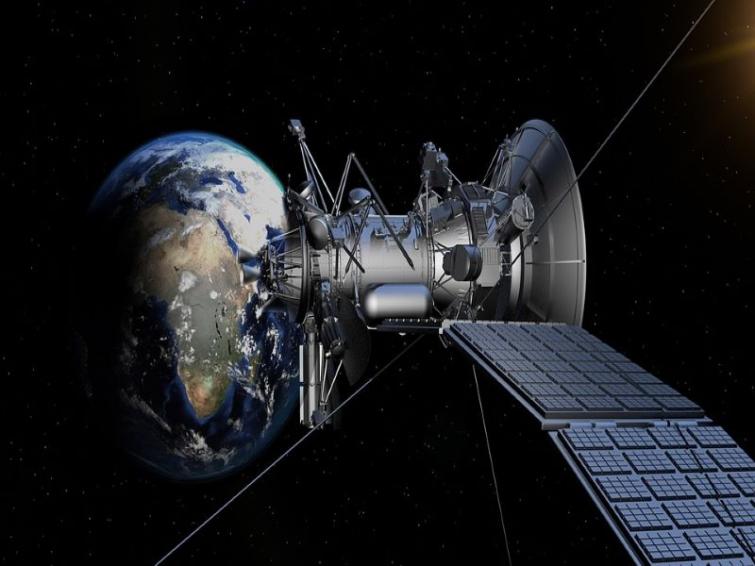
Iran's home-made satellite Zafar ready for launch
Tehran/Xinhua: The indigenous satellite Zafar has been delivered to Iran Space Agency (ISA) for launch, official IRNA news agency reported Sunday.
"The satellite will be put into orbit in the next three months," said Jabbar Ali Zakeri, an official of Iran University of Science and Technology that designed Zafar.
Zafar is a 90 kg remote-sensing satellite equipped with color cameras and can be used for surveying oil reserves, mines, jungles and natural disasters, according to Morteza Barari, deputy minister of Iran's Information and Communications Technology (ICT).
The satellite can move in circular orbit and send a message during its exploratory missions, added Barari, who also heads the ISA.
If the launch is successful, Zafar will orbit the earth for 18 months at an altitude of 530 km, the Iranian official noted.
Iran sent its first bio-capsule containing living creatures into space in February 2010, using a Kavoshgar-3 (Explorer-3) carrier.
Iran's first home-built satellite, Omid (Hope), was launched in 2009.
Support Our Journalism
We cannot do without you.. your contribution supports unbiased journalism
IBNS is not driven by any ism- not wokeism, not racism, not skewed secularism, not hyper right-wing or left liberal ideals, nor by any hardline religious beliefs or hyper nationalism. We want to serve you good old objective news, as they are. We do not judge or preach. We let people decide for themselves. We only try to present factual and well-sourced news.
Support objective journalism for a small contribution.