 Yemen
Yemen
‘I saw the blood on the tarmac’: top UN official in Yemen recounts aftermath of Israel airstrike on Sanaa airport
Fresh details of the Israeli airstrike on Sana’a airport, which occurred as Tedros Ghebreyesus, the Director-General of the World Health Organization (WHO) was preparing to fly out of the country, have been provided by Julien Harneis, the UN Resident and Humanitarian Coordinator in Yemen.
On 26 December, Israeli forces struck Sana’a International Airport, Red Sea ports and power stations. Tedros was at the airport when it was hit, along with Harneis and other members of a UN party negotiating the release of several UN workers held hostage by Ansar Allah, the de facto authorities in Sana’a.
Tedros and his colleagues were finally able to leave Yemen on Friday.
Harneis delivered a briefing to journalists from UN offices in Sana’a, in which he emphasized the importance of the airport to humanitarian aid efforts.
The following is an edited version of the briefing.
“I'm based in Yemen and had previously received Director General Tedros some two days before. He was here to engage with leaders of Ansar Allah, the de facto authorities in Sana’a, in order to contribute to negotiation for the release of UN staff. I was with him throughout those discussions.
Yesterday I was at the airport when the air strikes, which landed some 300 metres from us, destroyed the air traffic control centre, killing the staff working there and injuring a UN Humanitarian Air Service crew member.
The air strikes hit at around 4:45 PM. Not only did we have zero indication of any potential strikes, but we cannot remember the last time there were air strikes during daylight hours. So, an air strike on a civilian location and in the middle of the day, just before an Airbus 320 was about to land and with a UN party present was completely unexpected.
Our security colleagues took us, a party of approximately 20 UN personnel, out of the VIP building into five armoured vehicles. The injured UNHAS crew member was hit in the lower leg by shrapnel and had to be evacuated to a hospital in Sana’a: I saw his blood on the tarmac this morning as we said goodbye to Tedros. He underwent four hours of surgery and fortunately we were able to fly him out with Director General Tedros this afternoon.
‘If the airport is disabled it will paralyze humanitarian operations’
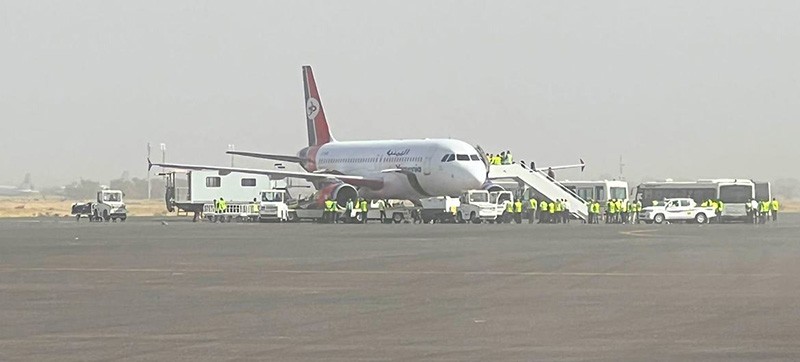
What was most frightening about that air strike wasn't the effect on us, it was that it began as a civilian airliner from Yemenia Airways, carrying hundreds of Yemenis, was about to land. In fact, the plane was taxiing when the air traffic control was destroyed.
Fortunately, that plane was able to land safely, and the passengers were able to disembark but it could have been far, far worse.
The airport is civilian infrastructure. It is where all the international humanitarian aid workers who work in the north of the country enter and leave, so if the airport is disabled it will paralyze humanitarian operations.
It's also the airport by which thousands of Yemenis who are unable to get advanced healthcare in the country leave for health facilities in Jordan, Cairo or Mumbai. So, it is an absolute vital humanitarian location. It is essential that all parties to the conflict scrupulously observe international humanitarian law.”
Support Our Journalism
We cannot do without you.. your contribution supports unbiased journalism
IBNS is not driven by any ism- not wokeism, not racism, not skewed secularism, not hyper right-wing or left liberal ideals, nor by any hardline religious beliefs or hyper nationalism. We want to serve you good old objective news, as they are. We do not judge or preach. We let people decide for themselves. We only try to present factual and well-sourced news.
Support objective journalism for a small contribution.