


 Nepal Disaster
Glacier breaks apart near 7,200m peak as drone records moment before deadly Nepal flash floods
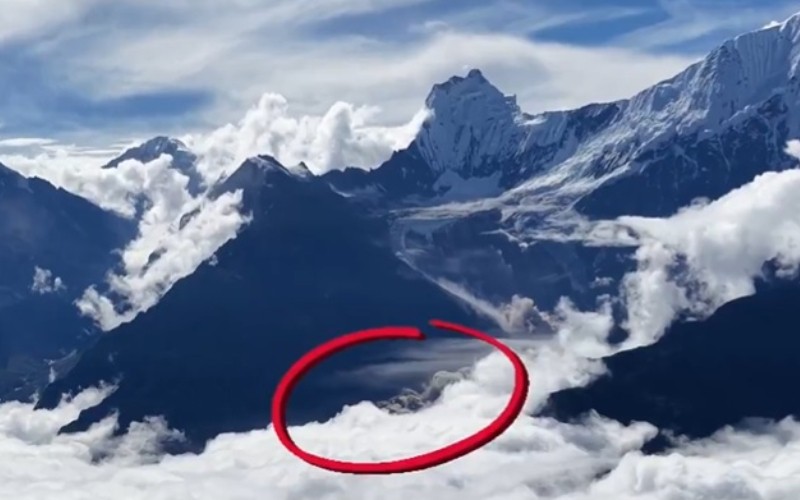
Drone footage has captured the dramatic moment when a huge mass of glacier ice and rock broke away from a mountain slope in Nepal, shortly before catastrophic flash floods swept through parts of the country and neighbouring Tibet.
The footage, recorded accidentally by a Chinese photographer, shows a vast section of bedrock and glacial ice collapsing near Langtang Lirung, a peak rising more than 7,200 metres above sea level.
As the mass broke away, enormous clouds of dust rose from the mountainside.
The mixture of ice, rock, mud and debris then plunged towards the valley below, about 1,200 metres beneath the collapse site.
The resulting surge contributed to a dramatic swelling of the Bhotekoshi and Trishuli rivers, triggering devastating flooding.
A Chinese photographer accidentally captured the catastrophic avalanche on Mount Lamtang in Nepal during a drone shoot.
— Massimo (@Rainmaker1973) August 28, 2026
[📹 HeyMu. Travel] pic.twitter.com/rgWylkezSC
The disaster struck on August 26, killing 903 people in Nepal and 16 in Tibet, according to the figures cited in the report.
More than 4,500 people remain missing, with most of those unaccounted for in Nepal.
Glacier collapse adds to scale of Nepal disaster
The newly surfaced footage offers a rare visual record of the chain of events preceding the floods, capturing the mountain collapse before the resulting debris and water reached populated areas.
The scale of the disaster has left Nepal's authorities struggling to establish the full extent of the damage amid difficult weather conditions, challenging terrain and continuing risks in affected areas.
Prime Minister Balendra Shah described the situation as an "unimaginable and heartbreaking natural disaster".
"Our country has been facing an unimaginable and heartbreaking natural disaster," Shah said in a social media post on Sunday night.
He said flooding along the Bhote Koshi River in Rasuwa had made it "extremely difficult to collect a complete account of the loss of life, property, and infrastructure".
"Although this task remains challenging due to adverse weather, difficult terrain, and ongoing risks, we are moving forward with determination to protect the lives of the citizens," Shah said.
"We will succeed in overcoming this crisis through our unity and collective efforts," he added.
Himalayan region has witnessed similar disasters
The Nepal disaster comes against a backdrop of several major rock, ice and glacial lake-related disasters across the Himalayan and Alpine regions in recent years.
In 2021, a massive rock-and-ice avalanche struck Uttarakhand after material cascaded down from Ronti Peak.
About 950 million cubic feet of rock and ice came down the mountain, with the material estimated to comprise roughly 80 percent rock and 20 percent ice.
The avalanche destroyed a hydropower plant and left around 200 people dead or missing, many of them workers at the project.
2023 Sikkim glacial lake outburst
A separate disaster struck Sikkim in 2023 when thawing permafrost contributed to a major rock collapse into South Lhonak Lake.
The impact generated a wave that breached the moraine holding back the glacial lake, producing a glacial lake outburst flood.
More than 13 billion gallons of water surged down the mountain.
The flood damaged several dams and affected more than 25,000 buildings and over 30 bridges.
The incident highlighted the risks posed by unstable mountain slopes and rapidly changing conditions around high-altitude glacial lakes.
2025 Swiss Alps glacier-related collapse
The phenomenon is not confined to the Himalayas.
In 2025, around 335 million cubic feet of rock and ice fell from the Birch Glacier in the Swiss Alps, burying much of the village of Blatten.
The incident added to a series of high-altitude disasters in which the destabilisation of ice, rock and mountain slopes has produced sudden and destructive downstream impacts.
Support Our Journalism
We cannot do without you.. your contribution supports unbiased journalism
IBNS is not driven by any ism- not wokeism, not racism, not skewed secularism, not hyper right-wing or left liberal ideals, nor by any hardline religious beliefs or hyper nationalism. We want to serve you good old objective news, as they are. We do not judge or preach. We let people decide for themselves. We only try to present factual and well-sourced news.
Support objective journalism for a small contribution.


