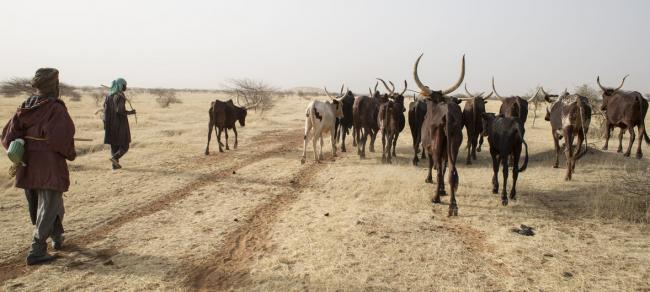
Fighting ‘existential crisis’ of encroaching desert sands
New York, Nov 2 (IBNS): In a move described as a landmark decision, the Group of Earth Observations (GEO) – a UN-backed partnership set up to improve Earth observation data-sharing and availability, to benefit all life – has launched a global initiative to reverse the “existential crisis” created by desertification and land degradation.
The key thrust of the initiative will see so-called “quality data” transferred into the hands of national and local decision-makers, where it can be used more effectively on the ground.
The UN Convention to Combat Desertification (UNCCD) says that land quality is getting worse in nearly all of the world’s countries, 169 in all, with related consequences including loss of wildlife, the internal displacement of populations, and forced migration.
Without urgent global and national climate action, Sub-Saharan Africa, South Asia and Latin America could see more than 140 million people move within their countries’ borders by 2050, increasing competition for dwindling space.
In September, the UN body urged the GEO to support them in implementing the Convention: the outcome is the Land Degradation Neutrality Initiative, launched at the 2018 GEO Congress in Kyoto on Thursday.
Land Degradation Neutrality is defined by the UNCCD as the amount and quality of land resources, necessary to support ecosystem functions and services and enhance food security, remaining stable or increasing.
The new commitment brings together data providers from around the world to strengthen monitoring and reporting, allowing governments - at the touch of a button - to access quality data and manage land better.
“Land degradation is an existential crisis. Until now, monitoring it in real time felt like an insurmountable challenge. No longer,” said Monique Barbut, Executive Secretary, United Nations Convention to Combat Desertification.
“With Earth observation datasets and the practical tools to use them readily available, decision-makers and land-users will have immediate and actionable information to scale up sustainable land management and planning. It is a first step to boosting our resilience,” she added.
Working groups have now been set up, to focus on areas such as data quality standards and big data computing platforms.
To date, 119 governments have pledged to take the measures needed to avoid, halt and reverse land degradation to ensure the amount of productive land stabilizes by 2030 and beyond.
FAO/Giulio Napolitano
Support Our Journalism
We cannot do without you.. your contribution supports unbiased journalism
IBNS is not driven by any ism- not wokeism, not racism, not skewed secularism, not hyper right-wing or left liberal ideals, nor by any hardline religious beliefs or hyper nationalism. We want to serve you good old objective news, as they are. We do not judge or preach. We let people decide for themselves. We only try to present factual and well-sourced news.
Support objective journalism for a small contribution.