Ex-Chief Justice Sushila Karki takes oath as Nepal’s first woman Prime Minister
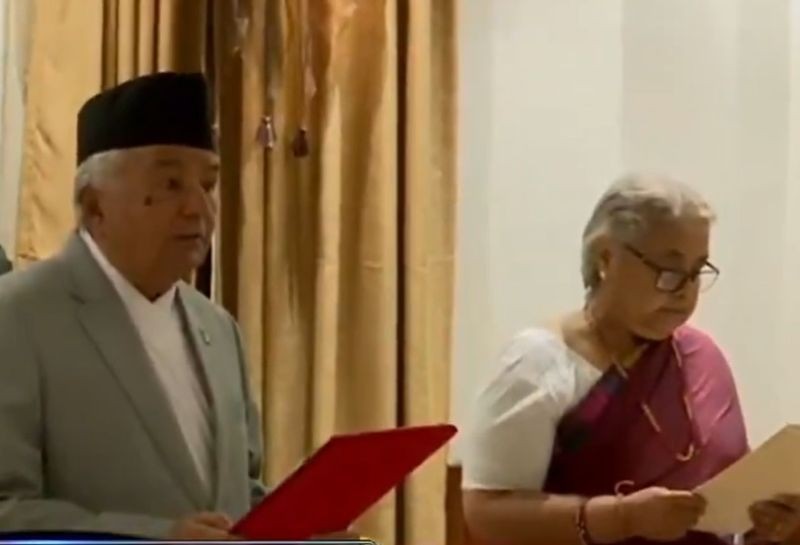
Former Chief Justice Sushila Karki was sworn in on Thursday as the interim Prime Minister of Nepal, becoming the country’s first woman to hold the post after days of violent protest and turbulence.
The ceremony took place at the Rashtrapati Bhawan in Kathmandu, capping days of political speculation and intense negotiations.
The oath was administered by President Ram Chandra Paudel in the presence of Vice President Ram Sahay Yadav and Chief Justice Prakash Man Singh Rawat.
#WATCH | Kathmandu | Nepal's former Chief Justice, Sushila Karki, takes oath as interim PM of Nepal
— ANI (@ANI) September 12, 2025
Oath administered by President Ramchandra Paudel
Video source: Nepal Television/YouTube pic.twitter.com/IvwmvQ1tXW
Following the ceremony, it was formally decided that general elections will be held on March 5, 2026.
Karki’s appointment comes amid a turbulent political climate marked by youth-led protests against corruption and restrictions on social media.
As interim leader, she is expected to head a small caretaker cabinet tasked with steering the country toward fresh elections.
The breakthrough comes after three days of nationwide protests, largely led by young demonstrators angered by corruption and a government ban on several social media platforms.
By Wednesday, Karki’s name had gained traction among the protesters as a consensus candidate to lead a transitional administration.
Who is Sushila Karki?
Sushila Karki, 71, made history as Nepal’s first woman Chief Justice. Known for her zero-tolerance stance on corruption, she is widely respected in legal and civil society circles.
She completed her BA at Mahendra Morang Campus and an MA in Political Science from Banaras Hindu University before earning a law degree at Tribhuvan University.
Initially a lecturer, she shifted to a career in law, rising to become a senior advocate before her appointment as Chief Justice in July 2016.
During her tenure, she presided over high-profile anti-corruption cases, including the conviction of former Information Minister Jaiprakash Prasad Gupta and a landmark ruling against Lokman Singh Karki, the former chief of the CIAA.
In 2017, she faced an impeachment motion brought by the Maoist-led government, widely viewed as politically motivated. The attempt was withdrawn after intense public backlash.
Nepal’s Gen-Z revolt: How a social media ban shook the nation
It began with silence. One September morning, young Nepalis woke to find their phones suddenly quieter: Facebook, YouTube, WhatsApp, X, and two dozen other apps had gone dark.
The government’s explanation was dry—these platforms had “failed to register” under new rules. But to a generation that lives, learns, and organizes online, it felt like something else entirely: censorship.
Within hours, the streets of Kathmandu were alive. University students, job-seekers, artists, and influencers poured into public squares, chanting against corruption, nepotism, and a political class they accused of living in luxury while ordinary citizens struggled.
What started as an angry pushback against a ban quickly swelled into something larger.
“Enough is enough!” became the rallying cry. Videos, ironically recorded before the blackout and later shared when access was restored, showed crowds marching through the capital, waving placards that read “Gen-Z for Change”.
But as the protests grew, so did the crackdown. By the second night, at least 19 demonstrators were dead.
The violence shocked the country. The very platforms the government tried to suppress turned into channels of outrage, as VPNs and backdoors allowed images of injured protesters to spread globally. International condemnation poured in.
Cornered, the government backtracked. Within three days, the social media ban was lifted, a rare victory wrested by youth power. Yet, the protests had already outgrown their original spark.
Calls grew louder for deeper change: an end to corruption, accountability from leaders, and new elections.
Political elites, long accustomed to horse-trading and fragile coalitions, suddenly seemed powerless before an angry, mobilized generation.
The protest compelled former Prime Minister KP Sharma Oli to resign.
Support Our Journalism
We cannot do without you.. your contribution supports unbiased journalism
IBNS is not driven by any ism- not wokeism, not racism, not skewed secularism, not hyper right-wing or left liberal ideals, nor by any hardline religious beliefs or hyper nationalism. We want to serve you good old objective news, as they are. We do not judge or preach. We let people decide for themselves. We only try to present factual and well-sourced news.
Support objective journalism for a small contribution.