Countries urged to make ‘digital world’ safer for children
New York: Rising Internet connectivity has the potential to transform children’s lives for the better, but also makes them vulnerable to sexual abuse, online harassment and bullying, recruitment by extremist groups, and other risks, according to a new UN-backed report published on Tuesday.
The study by the Broadband Commission for Sustainable Development underlines the need for everyone to ensure children remain safe as they explore “the digital world”.
It was produced by the Commission’s working group on Child Online Safety, comprising senior representatives from the UN, non-governmental organizations, law-enforcement agencies, regulators, and private companies.
The report lays out staggering statistics showing the extent and scale of the problem. For instance, in just one year the Internet Watch Foundation (IWF) found more than 105,000 websites hosting child sexual abuse material.
“It takes a village to keep children safe both online and offline. Therefore, all the stakeholders need to prioritize children, collaborate and generate collective actions to prevent and address all forms of violence, abuse and exploitation of children online,” members said in press release.
The report recommends that countries take immediate action, as no Government has developed fully effective protection systems.
Steps that protect children online include establishing a single national authority with ultimate responsibility for child online safety, as well as ensuring robust legislation is in place, among other measures.
The report also highlights the differences in Internet access depending on where young people live. Globally, there are more than two million people under the age of 18. Around 71 per cent of youth are already online, according to UNICEF research, cited in the report.
However, millions are still waiting to log on. Currently, 60 per cent of young Africans are not online but the number of users on the continent is growing by 20 per cent a year.
“In Sub-Saharan Africa, Asia and Latin America, connectivity has not yet reached all children. With the expansion of affordable broadband to these parts of the developing world, there is an urgent need to put in place measures to minimize the risks and threats to these children, while also allowing them to capitalize on all the benefits the digital world can bring to our societies,” the report said.
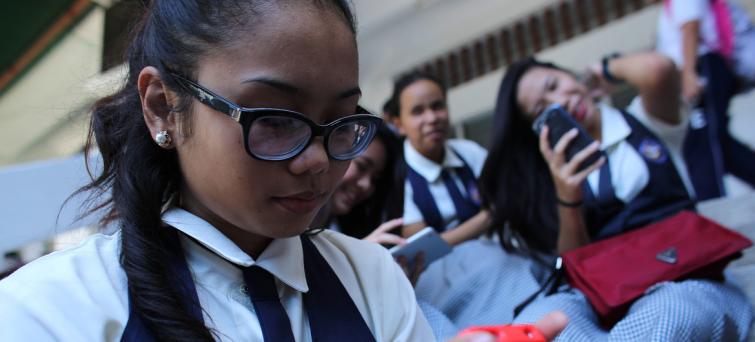
Photo caption and credit:
UNICEF/UN014974/Estey
Social media is a huge influence in children’s lives and being constantly connected to the Internet also comes with many risks, including online sexual exploitation, of adolescents and children.
Support Our Journalism
We cannot do without you.. your contribution supports unbiased journalism
IBNS is not driven by any ism- not wokeism, not racism, not skewed secularism, not hyper right-wing or left liberal ideals, nor by any hardline religious beliefs or hyper nationalism. We want to serve you good old objective news, as they are. We do not judge or preach. We let people decide for themselves. We only try to present factual and well-sourced news.
Support objective journalism for a small contribution.