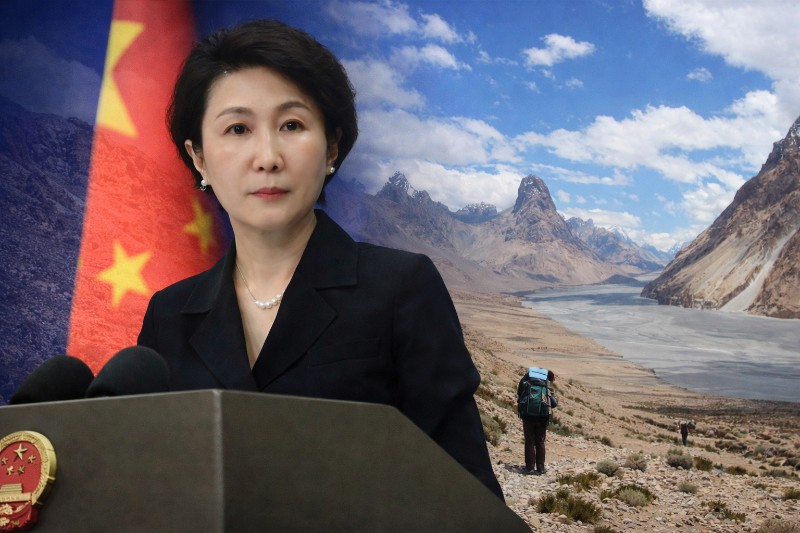
 Shaksgam Valley
China rekindles border tensions with Shaksgam Valley claim, India pushes back strongly
China has once again stirred diplomatic tensions with India by reiterating its controversial claim over the Shaksgam Valley in Jammu and Kashmir.
Beijing insisted that its infrastructure projects in the region are legitimate, dismissing New Delhi’s objections as baseless.
The statement came shortly after India criticised Chinese construction activities in the valley, asserting that the territory rightfully belongs to India and warning that it reserves the right to protect its interests.
The Shaksgam Valley, also known as the Trans Karakoram Tract, occupies a strategically sensitive location bordering China’s Xinjiang province.
Situated north of the Karakoram mountain range, the high-altitude region lies close to the disputed Siachen Glacier and Aksai Chin areas.
Administratively, it forms part of Pakistan-occupied Kashmir’s (PoK) Hunza-Gilgit region.
The 1963 pact that sparked the dispute
The dispute dates back to 1963, when Pakistan illegally transferred around 5,180 square kilometres of Indian territory in the Shaksgam Valley to China under the Sino-Pakistan Border Agreement.
India has consistently rejected the pact, calling it unlawful and invalid, and maintaining that Islamabad had no authority to cede Indian land.
New Delhi has long argued that the agreement violates India’s sovereignty and international norms.
Despite this, Beijing continues to reference the deal as the basis for its territorial claim.
Beijing’s latest statement
Responding to media queries in Beijing, Chinese Foreign Ministry spokesperson Mao Ning said that the Shaksgam Valley falls within Chinese territory.
She defended China’s construction projects in the area, claiming they were well within its sovereign rights.
Mao further pointed to the 1960s agreement between China and Pakistan, arguing that the two countries had settled their border issue decades ago.
She described the pact as a legitimate arrangement between two sovereign states.
However, critics note that Article 6 of the same agreement clearly states that once the Kashmir dispute between India and Pakistan is resolved, the boundary would need to be renegotiated with India.
This clause effectively undermines China’s claim of a permanently settled border.
India firmly rejects Chinese assertions
India swiftly responded to Beijing’s remarks.
The External Affairs Ministry spokesperson, Randhir Jaiswal, reiterated that the Shaksgam Valley is an integral part of Indian territory.
He categorically rejected the 1963 China-Pakistan agreement, describing it as illegal and null from India’s perspective.
Jaiswal also rejected the China-Pakistan Economic Corridor, pointing out that it passes through Indian territory under Pakistan’s illegal occupation.
He reaffirmed that Jammu and Kashmir and Ladakh remain inseparable parts of India.
The MEA spokesperson warned that India would take all necessary measures to safeguard its sovereignty and national interests.
China’s expanding presence in Shaksgam
Reports indicate that China has accelerated infrastructure development in the Shaksgam Valley, including the construction of an all-weather road.
These activities reportedly intensified after the 2017 Doklam standoff between India and China.
The proposed road lies less than 49 kilometres from the Siachen Glacier, the world’s highest battlefield.
While it may not immediately alter India’s defence posture, experts view the development as strategically significant.
In 2021, media reports suggested that Pakistan was exploring new land border crossings with China, potentially enhancing military coordination against Indian forces in Ladakh and Kashmir.
Strategic implications for the region
China’s growing footprint in Shaksgam and its renewed claims have raised concerns in New Delhi about the broader security implications.
Analysts view the move as part of Beijing’s long-term strategy to consolidate its presence in contested Himalayan regions while strengthening its partnership with Pakistan.
India, meanwhile, continues to diplomatically challenge China’s claims and construction activities, reiterating its position on territorial integrity at international forums.
As tensions persist, the Shaksgam Valley remains a flashpoint in the complex geopolitical rivalry between India and China, with regional stability hanging in the balance.
Support Our Journalism
We cannot do without you.. your contribution supports unbiased journalism
IBNS is not driven by any ism- not wokeism, not racism, not skewed secularism, not hyper right-wing or left liberal ideals, nor by any hardline religious beliefs or hyper nationalism. We want to serve you good old objective news, as they are. We do not judge or preach. We let people decide for themselves. We only try to present factual and well-sourced news.
Support objective journalism for a small contribution.