Canada's First Ministers agree to speed up power grid projects, labour mobility reforms amid U.S. tariff tensions
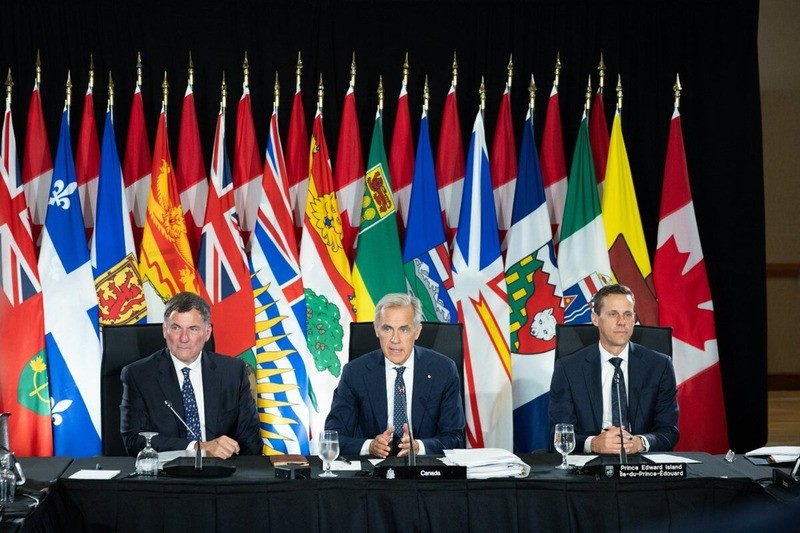
Charlottetown: Canada's first ministers agreed on Tuesday to accelerate electricity infrastructure projects, reduce internal trade barriers and reform carbon markets as they presented a united front against escalating U.S. trade actions.
Prime Minister Mark Carney and provincial and territorial premiers, meeting in Charlottetown, reaffirmed a "Team Canada" approach after discussing the latest U.S. tariffs, which Ottawa says violate the Canada-United States-Mexico Agreement (CUSMA).
The leaders said Canada remained ready to engage with Washington while continuing efforts to protect Canadian workers, businesses and farmers.
The meeting also focused on strengthening Canada's energy independence. First Ministers agreed to speed up work on electricity interties linking provinces and territories, with pre-development work to be completed by July 2027.
An initial group of projects is expected to begin by the end of 2027, with all projects targeted to be underway by the end of 2028, subject to market conditions and Indigenous engagement.
The commitments align with the federal government's recently released National Electricity Strategy, which aims to double Canada's electricity grid capacity by 2050 as demand rises from industrial growth, artificial intelligence and electrification.
The leaders also agreed to pursue an agreement in principle by the end of 2026 on mutual recognition legislation to improve labour mobility across provinces and territories, directing the Committee on Internal Trade to begin work immediately.
On climate policy, First Ministers agreed to establish a new federal-provincial-territorial working group by the end of the summer to examine linking industrial carbon markets across Canada.
The group will report by July 2027, while Carney committed to updating the national carbon pricing benchmark by the end of 2026.
The leaders also endorsed a federal-provincial-territorial action plan on community safety and agreed to begin discussions on long-term healthcare funding and productivity.
First Ministers acknowledged the severe wildfire season affecting several parts of Canada, thanking firefighters, emergency responders and Canadian Armed Forces personnel.
They also discussed federal support for wildfire-affected communities and the importance of continued coordination on emergency response.
The Charlottetown meeting marked the 14th First Ministers' meeting since March 2025 and the fifth held in person, underscoring what leaders described as a coordinated effort to strengthen Canada's economy, energy security and resilience amid global uncertainty.
Support Our Journalism
We cannot do without you.. your contribution supports unbiased journalism
IBNS is not driven by any ism- not wokeism, not racism, not skewed secularism, not hyper right-wing or left liberal ideals, nor by any hardline religious beliefs or hyper nationalism. We want to serve you good old objective news, as they are. We do not judge or preach. We let people decide for themselves. We only try to present factual and well-sourced news.
Support objective journalism for a small contribution.