Can science and technology really help solve global problems? A UN forum debates vital question
New York, May 2 (IBNS): Science and technology offer part of the solution to climate change, inequality and other global issues, a United Nations official said on Tuesday, spotlighting the enormous potential these fields hold for achieving humanity’s common goal, of a poverty and hunger-free world by 2030.
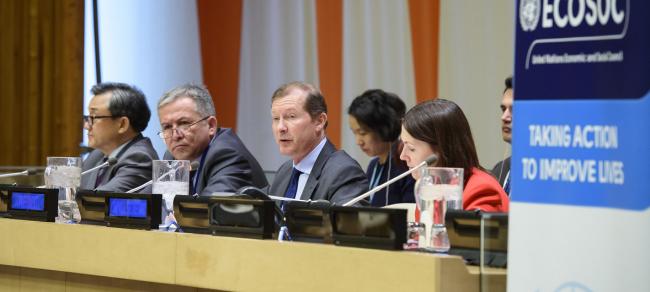
“New advances in science and technology hold immense promises for achieving the 2030 Agenda for Sustainable Development,” said UN Under-Secretary-General for Economic and Social Affairs, Liu Zhenmin, in his opening remarks to a session of the intergovernmental body overseeing the UN’s development work.
The 2018 Integration Segment of the Economic and Social Council (ECOSOC), being held from Tuesday to Thursday at UN Headquarters, brings together key stakeholders to review policies that support an integrated approach to achieving sustainable development and poverty eradication - with a focus this year on increasing resilience.
“To truly leverage the benefits of science and technology for sustainable development, we need to prioritize solutions that are pro-poor and equitable,” Liu said. “Only in this way can we ensure that no one is left behind.”
He stated that a rapidly warming planet was one of the greatest threats today, but a wide array of technological measures for climate change adaptation and mitigation can help the transition from carbon-intensive growth, towards more sustainable and resilient development.
Technologies can also help provide jobs to disadvantaged groups in society, and can help make cities smarter and more sustainable, by facilitating new transport systems and improving the management of natural resources.
To make new technology and innovation work in support of communities, any efforts must be driven on a local level, and be inclusive. Threatened by unsustainable consumption and production patterns, the ocean is also suffering, he added. Numerous technologies have been shown to help mitigate and address these effects, such as innovations in sustainable fishing; enhanced surveillance of ocean acidification, and environmentally-sensitive forms of pollution prevention and clean-up, he added.
Taking integrated approaches and working to break down barriers is of utmost urgency, too, as crises and shocks are increasingly complex and span the economic, social and environmental spheres.
“And, finally, we need to build capacities and institutions for anticipating risk, and for planning and strategic foresight to effectively leverage technologies,” Liu said.
Also addressing the opening segment was Marc Pecsteen, Vice-President of the Economic and Social Council, who said that technology and innovation have been identified as “two key enablers, whose appropriate, efficient, equitable and sustainable use can support our efforts to build and maintain resilient societies.”
Support Our Journalism
We cannot do without you.. your contribution supports unbiased journalism
IBNS is not driven by any ism- not wokeism, not racism, not skewed secularism, not hyper right-wing or left liberal ideals, nor by any hardline religious beliefs or hyper nationalism. We want to serve you good old objective news, as they are. We do not judge or preach. We let people decide for themselves. We only try to present factual and well-sourced news.
Support objective journalism for a small contribution.