


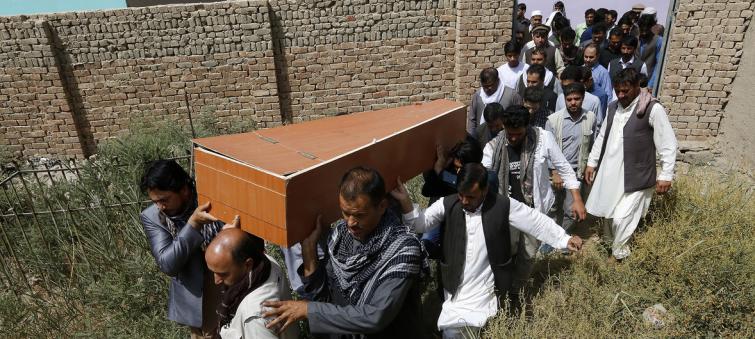
‘Answer the call of Afghans’ to reduce impact of conflict, UN urges all parties amid increase in civilian airstrike deaths
New York, July 31 (IBNS): The conflict in Afghanistan continues to be devastating for civilians, with the latest United Nations update released on Tuesday showing that the number of civilians killed by aerial operations increased in the first half of 2019, even as overall civilian casualties declined.
The mid-year report from the UN Assistance Mission in Afghanistan (UNAMA) documented 3,812 civilian casualties (1,366 deaths and 2,446 injured) in the first half of 2019.
While the number of civilians killed and injured is 27 per cent down from the same period in 2018 – the year that saw record high numbers of recorded civilian casualties – the UN noted “disturbing patterns”, such as the 27 per cent increase in civilian deaths in the second quarter of 2019 compared with the first.
Aerial operations from January through June killed and injured 519 people – 150 of which were child casualties (89 deaths and 61 injured) – a 39 per cent increase in civilian casualties from airstrikes compared to the same period last year, according to UNAMA.
UNAMA attributed 83 per cent of the civilian casualties resulting from aerial operations to International Military Forces, nine per cent to the Afghan Air Force, and the remaining eight per cent to undetermined pro-Government forces (PGFs).
At the same time, the UN Mission attributed 52 per cent of all civilian casualties to anti-Government elements, with 38 per cent attributed to Taliban, 11 per cent to Daesh/Islamic State Khorasan Province (ISKP), and three per cent to unidentified anti-Government elements.
The UN said that it supports the demand for all parties to reduce civilian casualties to zero, made in the joint declaration by Afghan participants earlier this month in Doha, Qatar at the Intra-Afghan Dialogue.
“Everyone heard the message loud and clear from Afghan delegates in the Doha talks – ‘reduce civilian casualties to zero!’” said Tadamichi Yamamoto, the UN Secretary-General’s Special Representative for Afghanistan.
“We urge all parties to heed this imperative, to answer the call of Afghans for immediate steps to be taken to reduce the terrible harm being inflicted,” added Yamamoto, who is also Head of UNAMA.
Conflict continues to severely impact women and children
According to UNAMA, women continue to be disproportionately impacted by the armed conflict in Afghanistan. Up to 30 June 2019, fighting caused 430 women casualties – 144 deaths and 286 injured – a decrease of 22 per cent compared to the same period in 2018.
Child casualties represented almost one-third of the overall total of civilian casualties, with 327 deaths and 880 injured. Children continue to comprise the vast majority – 84 per cent– of all civilian casualties from explosive remnants of war.
“Parties to the conflict may give differing explanations for recent trends, each designed to justify their own military tactics,” said Richard Bennett, UNAMA’s human rights chief.
“The fact remains that only a determined effort to avoid civilian harm, not just by abiding by international humanitarian law but also by reducing the intensity of the fighting, will decrease the suffering of civilian Afghans.”
UNAMA/Fardin Waezi
Support Our Journalism
We cannot do without you.. your contribution supports unbiased journalism
IBNS is not driven by any ism- not wokeism, not racism, not skewed secularism, not hyper right-wing or left liberal ideals, nor by any hardline religious beliefs or hyper nationalism. We want to serve you good old objective news, as they are. We do not judge or preach. We let people decide for themselves. We only try to present factual and well-sourced news.
Support objective journalism for a small contribution.


