 Aviation Chaos
New flight duty time limitation rules kicked in for all airlines. Why was IndiGo hit the hardest
While all airlines must comply with the new crew rest and fatigue-management norms, no carrier has been impacted as severely as IndiGo, India’s largest airline by a wide margin.
The carrier’s on-time performance plunged below 20 percent this week, and more than 1,200 flights have been cancelled over the past two weeks, prompting intervention from the Directorate General of Civil Aviation (DGCA).
What the new FDTL norms require
The revised FDTL rules, introduced by the DGCA to reduce pilot fatigue and align India with global safety practices, significantly expand weekly rest requirements and restrict night operations.
Pilots must now receive 48 consecutive hours of weekly rest instead of 36; night hours have been redefined as midnight to 6 am instead of 5 am, and night landings have been capped at two per week instead of six.
The norms also limit consecutive night duties and mandate comprehensive fatigue reporting and roster adjustments.
 Created with Google Gemini
These norms were planned in two phases.
The first phase, introduced in July 2025, expanded rest periods.
The second phase, implemented in November 2025, imposed new limits on night landings and overnight duties, creating the toughest operational constraints for airlines reliant on red-eye operations.
IndiGo, which had pushed for staggered implementation, faced the sharpest operational crunch once the second phase went live.
Why IndiGo’s operations crumbled first
IndiGo’s unprecedented disruptions stem from its scale, its network structure, and its cost-efficient model that depends on high aircraft utilisation and a lean staffing philosophy.
With a fleet of more than 400 aircraft operating over 2,200 to 2,300 daily flights, even a small percentage of cancellations translates into hundreds of grounded flights and thousands of stranded passengers.
Unlike full-service competitors, IndiGo schedules a high density of late-night and early-morning flights, most of which now fall under restrictive FDTL night-duty definitions.
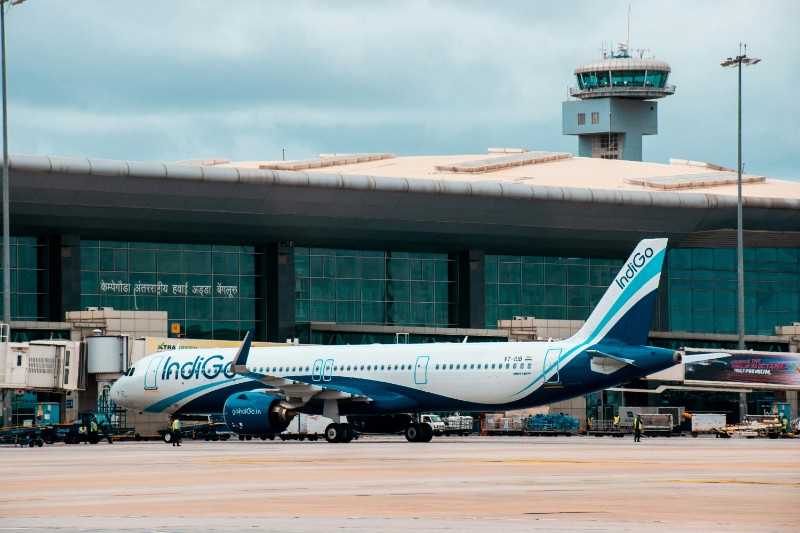
 Photo: Pexels/Saikat Bhowmik
The airline’s narrow-body fleet typically operates multiple daily sectors, meaning any disruption cascades rapidly.
If pilots hit duty-hour caps, IndiGo must find replacements immediately — an impossible task when staffing levels are already stretched thin.
Compounding matters, other carriers are currently operating below full capacity due to aircraft delivery delays and grounded jets awaiting maintenance, giving them more flexibility with rostering, whereas IndiGo operates at peak utilisation.
IndiGo admitted that 755 of its 1,232 cancelled flights in November were directly linked to FDTL and crew constraints.
Its on-time performance slid from 84.1 percent in October to 67.7 percent in November before crashing to below 20 percent in early December.
Passenger fallout across India’s airports
Chaos broke out at major airports, especially in Delhi, Mumbai, Hyderabad, Chennai, and Bengaluru, where queues stretched for hours, and travellers scrambled for alternative flights.
 Photo shared by IndiGo passenger Joy Bose (@joyboseroy) via X
Social media was filled with complaints about last-minute cancellations, long waiting times, unresponsive customer support, and a last-minute scramble for expensive tickets on other airlines.
Delhi airport was the worst hit, with IndiGo cancelling all 235 of its scheduled flights on one day.
"Need sanitary pad for my daughter," a visibly angry man could be heard venting at the Indigo crew amid hundreds of flight cancellations leaving passengers, in dire need of basic amenities, stranded for hours. pic.twitter.com/TRlMA27DVS
— Piyush Rai (@Benarasiyaa) December 5, 2025
Operations in Bengaluru, Hyderabad, Chennai, and Mumbai also faced major disruptions.
Many passengers were forced to spend hours at terminals, some missing connecting flights or important events.
Today, IndiGo has cancelled all its flights. More than 1,300 flights have been cancelled in the last three days.
— 🥇 Pragnya Gupta (@GuptaPragnya) December 5, 2025
• Elderly people, children, and women are facing immense difficulties.
• Passengers are stranded at airports for hours.
• Passengers are not receiving food or… pic.twitter.com/dxhLOafuQO
The situation deteriorated so quickly that the DGCA asked IndiGo to present a detailed explanation and mitigation plan.
Pilots' body says the crisis was 'foreseeable'
Pilot associations have strongly criticised IndiGo’s staffing and planning decisions.
The Airline Pilots’ Association of India (ALPA) said airlines received a clear implementation window, but IndiGo underestimated the operational impact and failed to adjust rosters 15 days in advance as required.
The Federation of Indian Pilots (FIP) went further, alleging that IndiGo knowingly adopted “a prolonged and unorthodox lean manpower strategy” despite a two-year preparatory window.
They pointed to a hiring freeze, non-poaching pacts, stagnant pilot pay, and attempts to reduce or buy back pilot leave as examples of shortsighted planning.
FIP also claimed that pilot morale suffered amid reports of senior executives receiving significant salary increments, while the airline blamed crew shortages for operational instability.
Some pilot groups have accused IndiGo of using widespread cancellations to push for regulatory relaxations — a charge the airline has denied.
They urged DGCA to grant seasonal slots only after verifying that airlines have sufficient pilot strength to meet FDTL norms.
IndiGo’s explanation: A convergence of 'operational challenges'
IndiGo has attributed the ongoing meltdown to multiple factors converging at once: technology issues, seasonal winter schedule changes, air traffic congestion, adverse weather, and the final enforcement phase of FDTL.
The airline insists that it is stabilising operations through “calibrated schedule adjustments,” which include rescheduling and cancelling select flights based on crew availability.
DGCA, meanwhile, has directed the airline to improve roster planning, enhance coordination with airports and air traffic control, and strengthen disruption-management protocols.
The regulator maintains that flight safety cannot be compromised and that FDTL implementation will not be rolled back.
The road ahead for India’s busiest airline
The coming weeks will test whether IndiGo can recover its stability or whether deeper structural weaknesses in staffing, scheduling, and operational planning will continue to haunt the carrier.
The airline has indicated that full compliance with the new norms will be achieved by February 2026, but for now, disruptions remain likely as winter fog sets in and schedules remain tight.
For passengers, the turbulence has turned into a cautionary tale about the fragility of high-utilisation airline models under new safety-focused regulations.
And for India’s aviation ecosystem, the crisis has ignited questions about preparedness, manpower planning, and the stress-test capacity of the country’s largest airline at a time of record air travel demand.
Support Our Journalism
We cannot do without you.. your contribution supports unbiased journalism
IBNS is not driven by any ism- not wokeism, not racism, not skewed secularism, not hyper right-wing or left liberal ideals, nor by any hardline religious beliefs or hyper nationalism. We want to serve you good old objective news, as they are. We do not judge or preach. We let people decide for themselves. We only try to present factual and well-sourced news.