


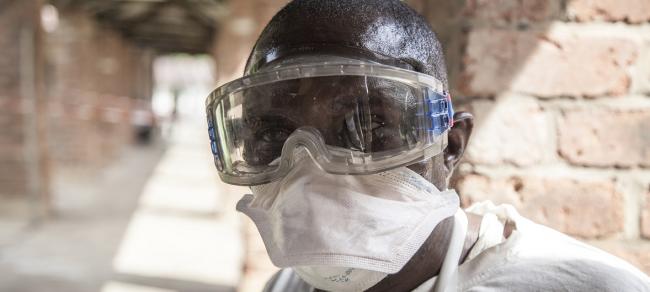
WHO reports ‘very strong progress’ in battling DR Congo Ebola outbreak
New York, June 9 (IBNS): One month after the start of an Ebola outbreak in the Democratic Republic of the Congo (DRC), United Nations health experts on Friday reported “very strong progress” in the response to the disease.
Dr. Peter Salama of the World Health Organization (WHO) told journalists in Geneva that the first phase — protecting urban centres and towns — "has gone well, and we can be cautiously optimistic.”
There have been 62 Ebola cases in the DRC during this latest oubreak, with 38 confirmations and 27 deaths.
The latest case, confirmed on Thursday, is in the remote Iboko health zone in the nort-hwest: an indication that the outbreak is ongoing.
Dr. Salama, the UN health agency’s Deputy Director-General for Emergency Preparedness and Response, was fresh from a two-day visit to the DRC.
“There’s been very strong progress in the outbreak response, particularly in relation to two of the initial three sites: Mbandaka and Bikoro,” he said.
Mbandaka, in northwest DRC, has a population of around one million.
It is the capital of Equateur province, where the small town of Bikoro also is located.
“We’re cautiously optimistic but there’s a lot of very tough work to do in phase two before we say that we’re on the top of this outbreak,” said Dr. Salama. “And we’ve learned the hard way in the past never to underestimate Ebola.”
The focus now is on rural isolated communities in the Iboko health zone which will present logistical and other challenges.
Dr. Salama described it as among the most remote territory on Earth, mainly inhabited by indigenous populations. WHO currently has 80 staff in the area.
“We’re talking about an enormous logistical effort required to reach every alert of a case. And then if there is a confirmation of a case, every contact of those cases,” he explained.
UNICEF/Naftalin
Support Our Journalism
We cannot do without you.. your contribution supports unbiased journalism
IBNS is not driven by any ism- not wokeism, not racism, not skewed secularism, not hyper right-wing or left liberal ideals, nor by any hardline religious beliefs or hyper nationalism. We want to serve you good old objective news, as they are. We do not judge or preach. We let people decide for themselves. We only try to present factual and well-sourced news.
Support objective journalism for a small contribution.


