


UNICEF reports uneven progress in 30 years of child rights treaty
New York/IBNS: Although the world has made historic gains over the past three decades in improving children’s lives, urgent action is required if the poorest children are to feel the impact, a new UN report published on Monday warns.
The study by the UN Children’s Fund (UNICEF) calls on countries to recommit to promises made under the Convention on the Rights of the Child, adopted 30 years ago.
Henrietta Fore, UNICEF Executive Director, noted that while increasing numbers of children are living longer, better and healthier lives, the odds continue to be stacked against the poorest and most vulnerable.
"In addition to the persistent challenges of health, nutrition and education, children today have to contend with new threats like climate change, online abuse and cyberbullying," she said.
"Only with innovation, new technologies, political will and increased resources will we help translate the vision of the Convention on the Rights of the Child into a reality for all children everywhere."
Uneven progress, emerging threats
The Convention on the Rights of the Child is the most widely and rapidly adopted international treaty in history, and has been ratified by more than 190 countries.
It acknowledges childhood, which lasts through age 18, as a special time in which children must be allowed to grow, learn, play, develop and flourish with dignity. 
UNICEF reported that since its adoption, the global rate for under-five mortality has dropped by around 60 per cent, while the proportion of undernourished children has almost halved.
The Convention has also influenced numerous constitutions, laws and policies that reflect its guiding principles, which include non-discrimination, the right to protection and acting in the best interests of the child.
However, the report shows that progress has not been even.
The poorest children are still likely to die from preventable causes before reaching their fifth birthday. Millions of the most disadvantaged are still at risk due to poverty, discrimination and marginalization. At the same time, cases of the childhood killer measles are on the rise as immunization coverage rates have slowed down since 2010.
Progress in education also is dismal. The report reveals that the number of primary level children out of school has remained static for more than a decade.
"Many of those who are in school are not learning the basics, let alone the skills they need to thrive in today’s economy," UNICEF added.
In recent years, young people have been speaking up and calling for action to address climate change. UNICEF said they are the ones most at-risk.
"Rapid changes in climate are spreading disease, increasing the intensity and frequency of extreme weather events, and creating food and water insecurity. Unless urgent action is taken, the worst for many children is yet to come," the UN agency warned.
Inclusive dialogue planned
UNICEF believes that where there is political will and determination, children’s lives improve, as documented by the report, which has been released ahead of World Children’s Day on 20 November.
The study calls for more data and evidence to accelerate progress and advance child rights, alongside recommendations such as involving young people in creating solutions.
UNICEF will use the coming 12 months to promote an inclusive global dialogue aimed at making the promise of the convention a reality for all children.
As Ms. Fore, the UNICEF chief, stated: "The Convention stands at a crossroads between its illustrious past and its future potential. It is up to us to recommit, take decisive steps and hold ourselves accountable."
Photo caption and credit:
UNICEF Patrick Brown
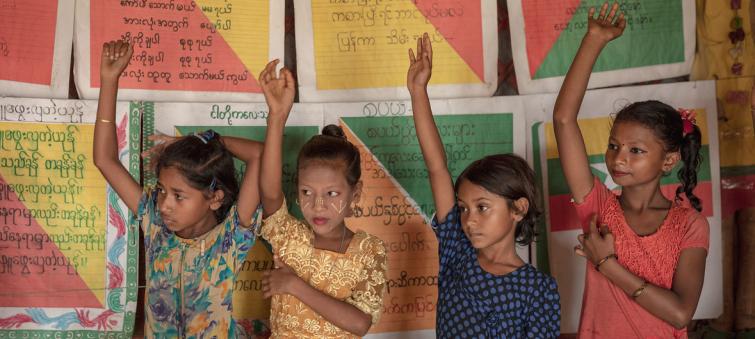
Children raise their hands to answer a question in class at a UNICEF learning space in Cox's Bazar, Bangladesh. (8 July 2019).
Support Our Journalism
We cannot do without you.. your contribution supports unbiased journalism
IBNS is not driven by any ism- not wokeism, not racism, not skewed secularism, not hyper right-wing or left liberal ideals, nor by any hardline religious beliefs or hyper nationalism. We want to serve you good old objective news, as they are. We do not judge or preach. We let people decide for themselves. We only try to present factual and well-sourced news.
Support objective journalism for a small contribution.


