


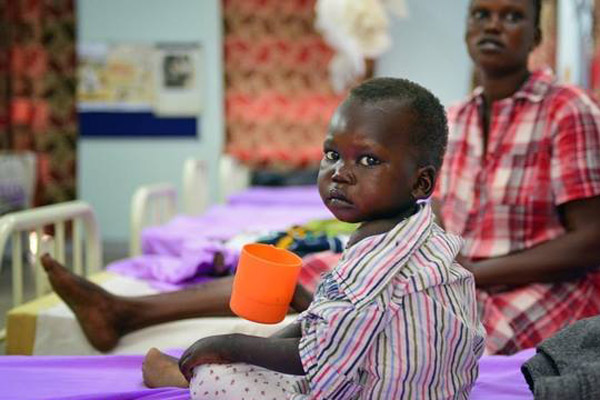
South Sudan: UN agency warns of catastrophic food shortages if conflict continues
Without such commitment, the country’s conflict areas face potentially catastrophic food shortages, UNICEF warned, pointing to the latest Integrated Food Security Phase Classification (IPC) group of experts’ report, which is released this week, and to its own latest nutrition survey, which supports the IPC’s findings.
“UNICEF needs access to remote areas made inaccessible because of the fighting,” the agency’s Representative in South Sudan, Jonathan Veitch, said. “This is where the crisis is forming. Both parties to the ceasefire need to reach a long-term settlement or face a growing food crisis by the end of the dry and lean season.”
Veitch said UNICEF and its partners are starting to see large numbers of people on the move in conflict areas because of food shortages. At least 229,000 children are estimated to be suffering from severe acute malnutrition in South Sudan – a number that has doubled since the start of the conflict just over a year ago.
“We remain on edge, and any increase in violence will see supply routes cut, markets disrupted and humanitarian access denied. This would be catastrophic for acutely malnourished children and could quickly lead to high levels of mortality.”
Working with the World Food Programme (WFP), UNICEF continues to step up aid for malnourished children across South Sudan. UNICEF and partners provided therapeutic feeding treatment for almost 100,000 severely malnourished in 2014 and are aiming to reach 137,000 children under five suffering from severe acute malnutrition in 2015.
UNICEF and WFP are also flying in expert teams to remote locations that are cut off from humanitarian aid, in what is called Rapid Response Missions. During these missions, UNICEF screens children for malnutrition and refers and treats those who are moderately and severely malnourished.
Staff will also register unaccompanied children in order to reunify them with their families, provide basic health and education services, and deliver supplies to provide safe water. More than 600,000 people, including over 142,000 children under the age of five, have been reached through 37 missions to date.
UNICEF is urgently appealing for additional funding of $34 million to continue to boost its nutrition response in South Sudan in 2015.
Photo: UNICEF/Christine Nesbitt
Support Our Journalism
We cannot do without you.. your contribution supports unbiased journalism
IBNS is not driven by any ism- not wokeism, not racism, not skewed secularism, not hyper right-wing or left liberal ideals, nor by any hardline religious beliefs or hyper nationalism. We want to serve you good old objective news, as they are. We do not judge or preach. We let people decide for themselves. We only try to present factual and well-sourced news.
Support objective journalism for a small contribution.


