


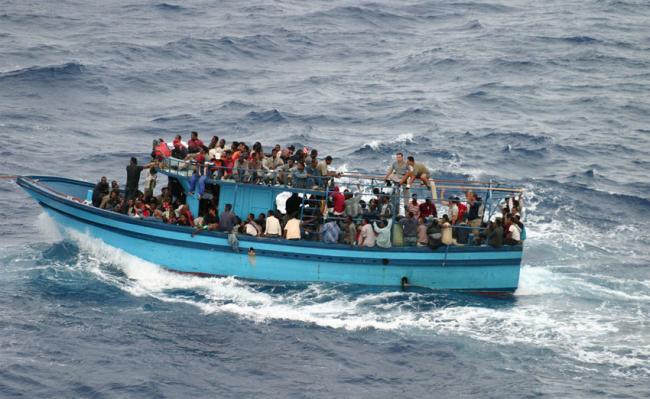
Refugee and migrant flows from Libya to Europe on the rise – UNHCR study
According to Mixed Migration Trends in Libya: Changing Dynamics and Protection Challenges, a study commissioned by the Office of the UN High Commissioner for Refugees (UNHCR), around half of those travelling to the country did so believing they could find jobs there, but ended up fleeing onwards to Europe to escape life-threatening insecurity, instability, difficult economic conditions and widespread exploitation and abuse.
“Foreign nationals going to Libya are part of mixed migration flows, meaning that people with different backgrounds and motivations travel together along the same routes, often with the help of ruthless people smugglers and criminal gangs,” said the UN agency in a news release on Monday, announcing the findings.
“They include refugees, asylum seekers, economic migrants, unaccompanied minors, environmental migrants, victims of trafficking and stranded migrants, among others.”
The study also found that almost 80 per cent of the refugees and migrants in Libya were young men (80 per cent), aged 22 on average and travelling alone (72 per cent).
Of particular concern was the rise in number of unaccompanied and separated children travelling alone, now representing some 14 per cent of all arrivals in Europe via the Central Mediterranean route, as well as women, particularly those from West and Central Africa, who could be victims of trafficking.
Refugees and migrants in Libya also tended to have a low level of education, with 49 per cent having little or no formal education and only 16 per cent having received vocational training or higher education, noted the study.
It also revealed that while economic reasons was the major factor motivating people to travel, many were also trying to flee violence, conflict or political persecution in their countries of origin.
In addition from people from within the African continent, the refugees and migrants in Libya also included individuals from as far as Syria, Iraq and Bangladesh.
However, many arriving in the country risk being kidnapped, held captive and abused by human smugglers or criminal gangs.
In the news release, UNHCR noted that conflict, instability and the collapse of the justice system and reigning impunity in Libya have contributed to an environment where human smuggling and criminal networks flourish.
In order to provide humanitarian assistance to those arriving as well as to the Libyans affected by the ongoing conflict, UNHCR is scaling up its response and recently issued an appeal for $75.5 million to strengthen protection monitoring and interventions, as well as advocacy on issues related to respect for human rights, access to basic services, asylum procedures and freedom of movement.
The UN agency is also stepping up efforts in Libya and the neighbouring countries to provide credible alternatives, find durable solutions and establish legal pathways for refugees and asylum seekers, as an alternative to dangerous trips to the country or over the Central Mediterranean Sea to Europe.
The study was commissioned by UNHCR and done by Altai Consulting, a specialised consulting firm that focuses on research, monitoring and evaluation in fragile states, and IMPACT Initiatives, a Geneva-based think-tank that assesses, monitors and evaluates aid programmes.
Its findings are primarily based on qualitative data – including interviews with refugees and migrants – collected in Libya, Algeria, Chad, Italy, Niger and Tunisia, between October and December 2016.
Photo: UNHCR/L.Boldrini
Source: www.justearthnews.com
Support Our Journalism
We cannot do without you.. your contribution supports unbiased journalism
IBNS is not driven by any ism- not wokeism, not racism, not skewed secularism, not hyper right-wing or left liberal ideals, nor by any hardline religious beliefs or hyper nationalism. We want to serve you good old objective news, as they are. We do not judge or preach. We let people decide for themselves. We only try to present factual and well-sourced news.
Support objective journalism for a small contribution.


