


National security legislation will bring Chinese system to Hong Kong: Report
Beijing: The implementation of the Hong Kong national security legislation will make the mainland China's legal system effective on the city that has witnessed violent protests against the law in recent times.
While the widely-opposed rendition bill was ultimately withdrawn, critics say newly proposed national security legislation will effectively bring the mainland’s legal system to Hong Kong, with China’s National People’s Congress empowered to write and apply the still pending law without the approval of the territory’s legislature, reports Asia Times.
Though Beijing is yet to confirm the bill’s relevant clauses, officials have indicated that those in breach of the law, which will punish secession, subversion, terrorism and foreign interference in the city’s affairs, could be extradited to the mainland for trial, just as the earlier, now shelved proposal controversially sought, the Hong Kong-based news paper reported.
Many see the precedent set by the central government using exemptions in Hong Kong’s Basic Law, the territory’s de facto constitution, to impose the new legislation as an inflection point that could spell the end of the “one country, two systems” framework enshrined in the 1984 Sino-British Joint Declaration that guarantees the city’s high degree of autonomy, reported the newspaper.
Civic Party opposition lawmaker Tanya Chan said the legislation showed that the Communist Party has lost patience on people of Hong Kong and its administration.
“This national security legislation shows that the Communist Party has lost its patience and confidence in ‘one country, two systems’, as well as the Hong Kong people and our administration,” Civic Party opposition lawmaker Tanya Chan told Asia Times. “This is a warning and a reminder to Hong Kong people about who’s the boss.”
Foreign Ministers of the Group of Seven (G7) member countries have asked China to reconsider its decision to impose national security legislation on Hong Kong.
"The proposed national security law would risk seriously undermining the 'One Country, Two Systems' principle and the territory's high degree of autonomy. It would jeopardize the system which has allowed Hong Kong to flourish and made it a success over many years," the foreign ministers of United States, Canada, France, Germany, Italy, Japan, the United Kingdom, and the EU's High Representative said in the statement as quoted by ANI.
"We are also extremely concerned that this action would curtail and threaten the fundamental rights and freedoms of all the population protected by the rule of law and the existence of an independent justice system," the foreign ministers said.
The countries asked China to reconsider the decision on the crucial issue that has triggered protests in the city.
"We strongly urge the Government of China to reconsider this decision," the leaders stressed in the statement.
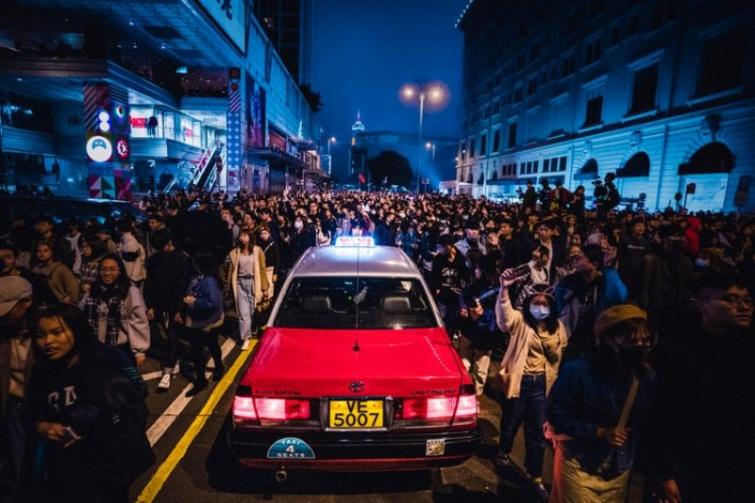
China's parliament recently backed a new security bill meant to bring about tighter control over Hong Kong, which underlines that anyone who undermines Beijing's authority in the territory will be treated as a criminal and his/her action will be deemed crime against the state.
The new bill has caused deep concern among those who say it could end Hong Kong's unique status.
The move has already sparked a new wave of anti-mainland protest.
Support Our Journalism
We cannot do without you.. your contribution supports unbiased journalism
IBNS is not driven by any ism- not wokeism, not racism, not skewed secularism, not hyper right-wing or left liberal ideals, nor by any hardline religious beliefs or hyper nationalism. We want to serve you good old objective news, as they are. We do not judge or preach. We let people decide for themselves. We only try to present factual and well-sourced news.
Support objective journalism for a small contribution.


