


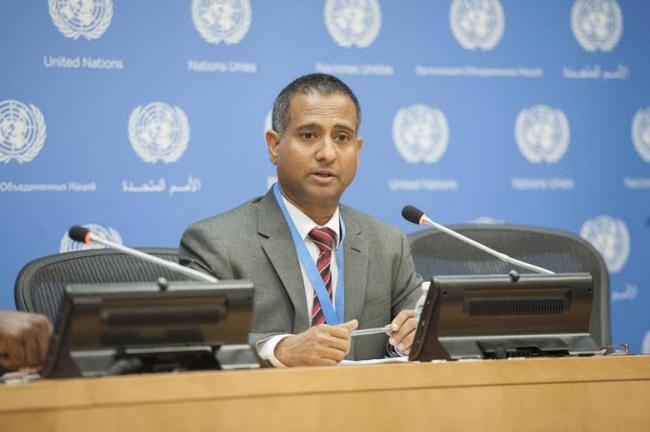
Iran: UN experts urge 'immediate halt' over scheduled execution of juvenile
“Regardless of the circumstances and nature of the crime, the execution of juvenile offenders is clearly prohibited by international human rights law,” Ahmed Shaheed, Special Rapporteur on the situation of human rights in Iran, and Christof Heyns, the UN Special Rapporteur on extrajudicial executions, declared in a press release issued earlier today.
“The imposition of the death penalty in Iran contrasts the current international trend of abolishing the death penalty in law and in practice,” they added.
Saman Naseem, who was 17 at the time of his arrest in 2011, was allegedly subjected to torture and made to confess to the crimes of “Moharebeh,” or “enmity against God,” and “Ifsad fil Arz,” or “corruption on Earth,” for his suspected involvement in armed activities with the Party of Free Life of Kurdistan. He was sentenced to death in April 2013.
According to a UN human rights report released last year, the new Islamic Penal Code that entered into force in 2013 now omits references to apostasy, witchcraft and heresy, but continues to allow for juvenile executions and retains the death penalty for activities that do not constitute most serious crimes in line with the safeguards guaranteeing protection of the rights of those facing the death penalty such as adultery, repeated alcohol use, and drug possession and trafficking.
Nonetheless, the independent experts recalled the “repeated assertions” by Iranian authorities that confessions obtained under torture were inadmissible under Iranian law while noting that the country was also party to the International Covenant on Civil and Political Rights and to the Convention on the Rights of the Child.
Iran has witnessed a surge in executions over the past two years.
At least 852 individuals were reportedly executed between July 2013 and June 2014, representing an “alarming” increase in the number of executions in relation to the already-high rates of previous years, according to UN estimates. In addition, at least 60 persons, including four women, have reportedly been executed in January 2015 alone.
UN Photo/Cia Pak
Support Our Journalism
We cannot do without you.. your contribution supports unbiased journalism
IBNS is not driven by any ism- not wokeism, not racism, not skewed secularism, not hyper right-wing or left liberal ideals, nor by any hardline religious beliefs or hyper nationalism. We want to serve you good old objective news, as they are. We do not judge or preach. We let people decide for themselves. We only try to present factual and well-sourced news.
Support objective journalism for a small contribution.


