


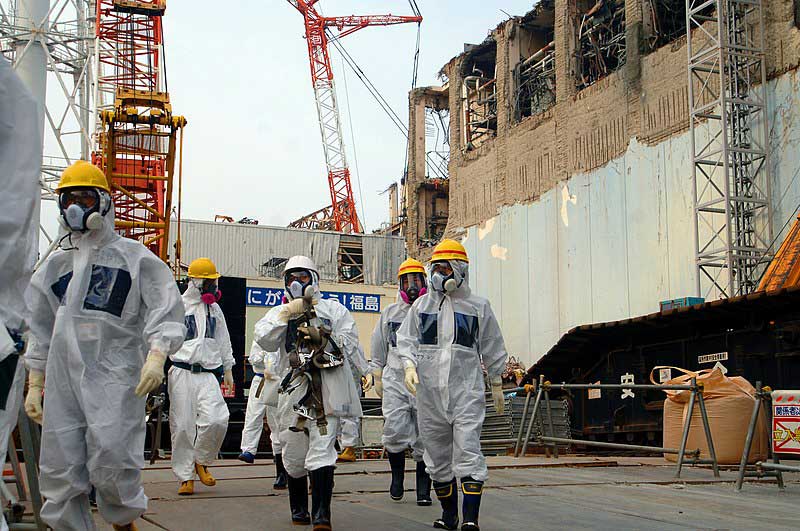
 Fukushima
IAEA finds Japan’s plans to release treated water into the sea at Fukushima consistent with international safety standards
An International Atomic Energy Agency (IAEA) safety review has concluded that Japan’s plans to release treated water stored at the Fukushima Daiichi nuclear power station into the sea are consistent with IAEA Safety Standards.
In a report formally presented by Director General Rafael Mariano Grossi to Japanese Prime Minister Fumio Kishida in Tokyo today, the IAEA also said that the discharges of the treated water would have a negligible radiological impact to people and the environment.
The report is the outcome of nearly two years of work by an IAEA Task Force made up of top specialists from within the Agency advised by internationally recognised nuclear safety experts from eleven countries. They reviewed Japan’s plans against IAEA Safety Standards which serve as a global reference for protecting people and the environment and contribute to a harmonized high level of safety worldwide.
“Based on its comprehensive assessment, the IAEA has concluded that the approach and activities to the discharge of ALPS treated water taken by Japan are consistent with relevant international safety standards,” IAEA Director General Rafael Mariano Grossi said in a foreword of the report.
“Furthermore, the IAEA notes the controlled, gradual discharges of the treated water to the sea, as currently planned and assessed by TEPCO, would have a negligible radiological impact on people and the environment,” he added.
After taking the decision in April 2021 to discharge the water stored at the Fukushima Daiichi nuclear power station (FDNPS) into the sea, Japan requested the IAEA to conduct a detailed review of the safety related aspects of plan.
IAEA Director General Grossi accepted Japan’s request and committed to be involved before, during, and after the water discharges.
The water stored at the FDNPS has been treated through an Advanced Liquid Processing System (ALPS) to remove almost all radioactivity, aside from tritium. Before discharging, Japan will dilute the water to bring the tritium to below regulatory standards.
Like elsewhere in the world, decisions related to nuclear safety are a national responsibility and Japan’s Nuclear Regulation Authority (NRA) approved the plan in May.
The IAEA’s review addressed all key safety elements of the water discharge plan in three major components: assessment of protection and safety; regulatory activities and processes; and independent sampling, data corroboration, and analysis.
Over the past two years, the Task Force has conducted five review missions to Japan, published six technical reports, and met many times with the Japanese Government and Japan’s Tokyo Electric Power Company (TEPCO), the FDNPS operator, and analysed hundreds of pages of technical and regulatory documentation. Task Force members have also several times visited the site in eastern Japan to review discharge preparations there.
Director General Grossi said the report issued today “represent a significant milestone in the IAEA’s review” but that “our task is only just beginning”.
“The IAEA will continue to provide transparency to the international community making it possible for all stakeholders to rely on verified fact and science to inform their understanding of this matter throughout the process,” he said.
The IAEA‘s safety review will continue during the discharge phase. The Agency will also have a continuous on-site presence and provide live online monitoring on its website from the discharge facility.
“This will ensure the relevant international safety standards continue to be applied throughout the decades-long process laid out by the Government of Japan and TEPCO,” Director General Grossi said.
Support Our Journalism
We cannot do without you.. your contribution supports unbiased journalism
IBNS is not driven by any ism- not wokeism, not racism, not skewed secularism, not hyper right-wing or left liberal ideals, nor by any hardline religious beliefs or hyper nationalism. We want to serve you good old objective news, as they are. We do not judge or preach. We let people decide for themselves. We only try to present factual and well-sourced news.
Support objective journalism for a small contribution.


