


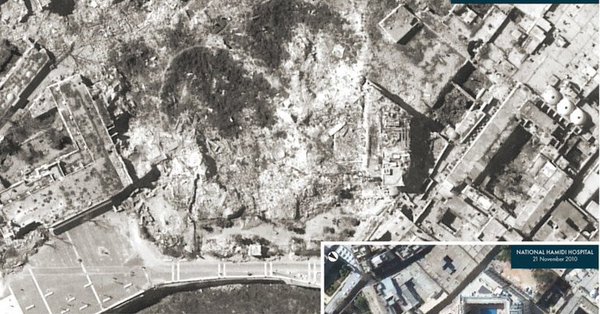
First full satellite survey of devastated ancient Aleppo raises recovery hopes
New York, Dec 18 (IBNS): The first comprehensive survey of the devastation inflicted on the ancient Syrian city of Aleppo by years of urban warfare, has been published thanks to ground-breaking satellite imaging tools, developed by UN agencies – an essential first step towards its eventual reconstruction.
The study, “Five Years of Conflict: The State of Cultural Heritage in the Ancient City of Aleppo,” was made possible thanks to the work of satellite imagery analysts from the UN Institute for Training and Research (UNITAR), and culture heritage experts from the UN Educational, Scientific and Cultural Organization (UNESCO), working closely with historians, architects and archaeologists.
The technology allowed them to remotely assess the damage, immediately following the end of the years-long siege of east Aleppo in 2016. It also made it possible, for the first time, to monitor areas rendered inaccessible by continuing security challenges and restricted access to the city.
The study shows that, between 2014 and 2015, most of the historic buildings south of the ancient Citadel were destroyed or severely damaged, including the New Serail, Madrasa al-Sultaniyya, Hammam Yalbougha al-Nasiri and al-Khusrawiyya Complex. It provides assessments of 518 properties, including the Citadel and the city’s Great Mosque.
Introducing the report, Audrey Azouley, Director-General of UNESCO, said that the technology provides a “remarkable tool with unmatched precision for documenting and understanding heritage” adding that it could also pave the way “for the eventual recovery of the city.”
Aleppo’s history stretches back over 4,000 years, with a succession of civilizations, including Hittite, Greek, Roman and Ayyubid, leaving their mark on the city over the centuries. It is one of six Syrian World Heritage sites added to UNESCO’s List of World Heritage in Danger in 2013.
Until it was engulfed by intense fighting in 2012 between Government and opposition forces, Aleppo was viewed as one of the best examples of urban conservation and preservation, said Ms. Azouley. Today, it lies largely in ruins, with its “invaluable centuries-old landmarks severely damaged or destroyed.” The report shows that 10 percent of the historic buildings of Aleppo have been destroyed and more than half the buildings assessed showed severe to moderate damage.
The eventual restoration of Aleppo, with the help of the technology developed by the UN, is highlighted by UNESCO as an important part of the process of healing communities in the wake of conflict and other crises. The agency has offered its assistance to the residents of the city in rebuilding their neighbourhoods, so that future generations can appreciate its unique heritage once conditions allow.
This video, produced by UNESCO and Japanese broadcaster NHK, shows historic sites of Aleppo, as they were before the Syrian conflict.
Support Our Journalism
We cannot do without you.. your contribution supports unbiased journalism
IBNS is not driven by any ism- not wokeism, not racism, not skewed secularism, not hyper right-wing or left liberal ideals, nor by any hardline religious beliefs or hyper nationalism. We want to serve you good old objective news, as they are. We do not judge or preach. We let people decide for themselves. We only try to present factual and well-sourced news.
Support objective journalism for a small contribution.


