


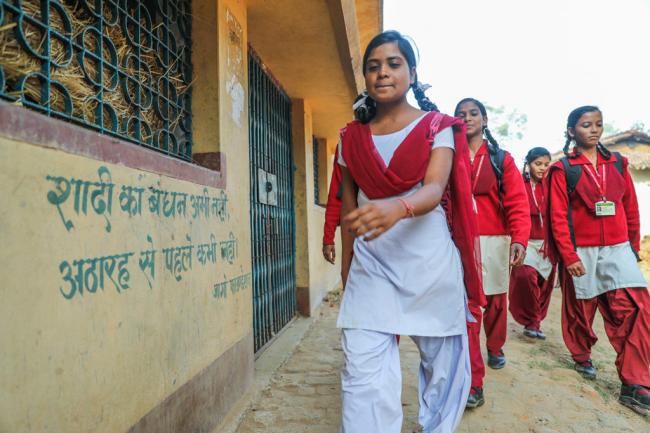
Education critical in preventing adolescent pregnancy, underscores UN agency
“[For] each additional year of education, [there is] a 10 per cent reduction in fertility,” said UN Educational, Scientific and Cultural Organization (UNESCO) in a news release, announcing the paper.
According to Early and unintended pregnancy: Recommendations for the education sector, in addition to the detrimental effects on health, social, economic and education of adolescent girls, early and unintended pregnancy also put the young mother's and the child's lives at risk.
“Pregnancy and childbirth complications are the second cause of death among 15- to 19-year-olds, with approximately 70,000 adolescents affected annually,” added UNESCO.
With the new technical paper, the UN agency aims to bridge the lack of operational guidance for the education sector on how to address early and unintended pregnancy, with recommendations including promotion of re-entry policies, comprehensive sexuality education for pregnancy prevention, access to school health services and safe school environments for girls.
In particular, it points to a review undertaken of 58 programmes in India which found that girls with secondary schooling were 70 per cent less likely to marry as children than illiterate girls.
It was commissioned to help Governments and education actors understand the effects of early and unintended pregnancy and the actions necessary to prevent it while also ensuring that all girls, including those who are pregnant and parenting, can realize their right to education in a safe and supportive school environment.
“Great strides are being made in improving access and retention for girls in the school system [but] policy implementation regarding early and unintended pregnancy must be emphasized to ensure the continuation of girls' education in a safe and supportive environment,” underscored UNESCO.
In addition to the direct benefit for girls and their families, addressing this pressing problem also contributes to achievement of several Sustainable Development Goals (SDGs) including Goal 1 on eliminating poverty, Goal 3 on promoting healthier lives, Goal 5 on achieving gender equality and Goal 16 on building peaceful and inclusive societies.
“Pregnancy has to be integrated into the wider subject of life skills or sexuality education, not as a short, stand-alone topic,” said Joanna Herat, a UNESCO official associated with its project on combatting early and unintended pregnancy.
“By integrating it into life skills or sexuality education, it also means that it is taught to both boys and girls – recognizing that both male and female learners have a role to play in making decisions about healthy sexual relationships, now and in the future.”
The brief has been produced by UNESCO in collaboration with the UN Population Fund (UNFPA), the Ford foundation and Step Up, Strengthening evidence for programming on unintended pregnancy, is based on detailed review of evidence. Its launch coincides with the 2017 London Family Planning Summit.
Photo: UNICEF/Prashanth Vishwanathan
Source: www.justearthnews.com
Support Our Journalism
We cannot do without you.. your contribution supports unbiased journalism
IBNS is not driven by any ism- not wokeism, not racism, not skewed secularism, not hyper right-wing or left liberal ideals, nor by any hardline religious beliefs or hyper nationalism. We want to serve you good old objective news, as they are. We do not judge or preach. We let people decide for themselves. We only try to present factual and well-sourced news.
Support objective journalism for a small contribution.


