


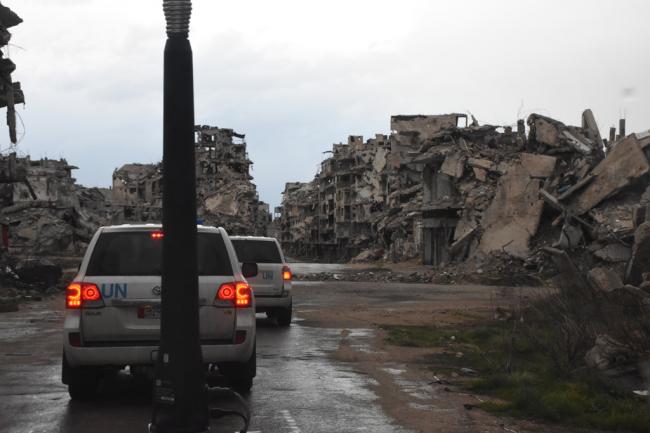
Delays in access in Syria ‘will mean further death,’ warns top UN relief official
Briefing the Security Council on Thursday, Stephen O’Brien, the Under-Secretary-General for Humanitarian Affairs, also underlined the need for a sustained reduction in fighting to ease the burden on civilians and create an environment conducive for assistance.
“Now is the time. Any delay will mean further death. The clock is ticking,” he warned.
The Syrian conflict, now into its seventh year, has taken a terrible toll on the country’s population: hundreds of thousands have been killed, more than 13.5 million left in need of humanitarian assistance, about 6.3 million displaced within the country, and some 5.1 million forced to flee as refugees outside its borders.
The situation is particularly dire in Raqqa, where the Syrian Democratic Forces, supported by coalition forces, launched an offensive to take the city from the Islamic State in Iraq and the Levant (ISIL/Da’esh), and in the last days fully encircled it.
According to the Office of the UN High Commissioner for Human Rights (OHCHR), at least 173 people have been reportedly killed in air and ground strikes. Although about 25,000 have reportedly fled the city since the latest phase of operations, as many as 100,000 civilians could still be trapped there, said O’Brien.
Multitude of challenges for aid workers
On relief operations in Syria, O’Brien said that the work of humanitarians remains extremely difficult and bureaucratic restrictions on top of attacks and removal of relief supplies has made their operating space incredibly complex and complicated.
Bureaucratic restrictions, he said, delay convoys and often force them to abort their missions or turn around, leaving relief workers vulnerable to attacks.
In one such incident, a driver of a truck was hit by sniper fire from unknown gunmen after his convoy had to turn back to avoid travelling at night. The convoy had been stopped for several hours at a Government checkpoint. A bullet also grazed a second driver.
The injured driver survived and is in stable condition, said O’Brien.
“I condemn such acts in the strongest terms, and call for accountability for those responsible,” he stressed. “Those who deliberately direct attacks against humanitarian workers are committing war crimes.”
Over half a million trapped in besieged locations across Syria
Turning to the besieged locations across the country, the Emergency Relief Coordinator informed the Council that the town of Madaya (in rural Damascus) and the Al-Wa’er district in Homs are being removed from the “besieged” list following improvement in access, reducing the number of besieged places to 11.
However, over half a million people still remain at these locations, “trapped and desperate for assistance,” said O’Brien. Collectively, about 4.5 million Syrians are estimated to remain in the besieged and hard-to-reach areas across the country. He also updated the Council of recent deployments of trucks from the UN World Food Programme (WFP) from Aleppo, through Menbij and to Qamishly in Hassakeh governorate, allowing delivery of aid at scale to north-east Syria, where people had been short of supplies since the closure of a cross-border access point with Turkey in December 2015.
“This is particularly important with growing needs in the north- Syria due to anti-ISIL operations in the area,” said O’Brien.
This route is also much cheaper than relief air drops from Damascus, resulting in savings that are equivalent to providing food aid for 100,000 people for one year.
O’Brien said that he looked forward to next week’s meeting in Astana, the capital of Kazakhstan, on de-escalation and hope that it would bring a sustained reduction of fighting, and along with that improved and unhindered humanitarian access.
“I repeat my call for this Council to act now to protect civilians,” he urged, while also calling on the parties to the conflict and those with influence over them to prioritize protection of civilians. “These are legal obligations under the laws of war, and they cannot be bent, broken or avoided.”
Humanitarians have persisted at great costs – UN regional relief official
Also on Syria, Kevin Kennedy, the Regional Humanitarian Coordinator for the Syria Crisis, told journalists in New York of the scale of the suffering in the war-torn country.
Perhaps the most egregious feature of the conflict, he said, was the persistent bombing of hospitals and medical facilities.
In the first six months of this year, at least 96 such bombings have been reported, of which 60 have been confirmed by the UN. Fifteen doctors and nurses have lost their lives and dozens more have been injured.
“If you are a doctor or nurse – working particularly in opposition-held area – and go to work in a hospital or clinic, then you work in a building with a big bullseye [target mark] on its roof,” said Kennedy, who is finishing up his assignment.
Praising the efforts of UN, international and national non-governmental humanitarian workers, he said that they have stood their ground.
“[They] have stayed there despite being bombed, shot at, mortars landing around them on a weekly basis […] and despite suffering casualties […] and carried on at a great sacrifice,” he stated.
Photo: UNICEF/Ebo
Source: www.justearthnews.com
Support Our Journalism
We cannot do without you.. your contribution supports unbiased journalism
IBNS is not driven by any ism- not wokeism, not racism, not skewed secularism, not hyper right-wing or left liberal ideals, nor by any hardline religious beliefs or hyper nationalism. We want to serve you good old objective news, as they are. We do not judge or preach. We let people decide for themselves. We only try to present factual and well-sourced news.
Support objective journalism for a small contribution.


