


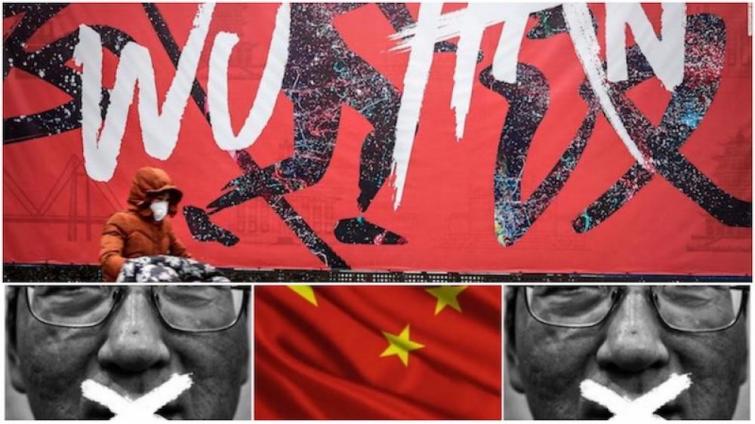
COVID-19 episode unveils China's local censorship storyÂ
The COVID-19 outbreak may have opened a major Pandora's box in China where people are facing censorship if they try to reveal the truth behind the disease that has now spread globally.
For instance, take the case of Cui Yongyuan, a former state media television host and a blogger on Weibo, found his account was blocked last month.
Cui was known for his social commentary and whistle-blowing.
But last year his posting stopped and in May he found that posts containing his nickname “Xiaocui” had been blocked, reported South China Morning Post.
Not only on Weibo, he faced the same trouble with his WeChat account.
That same month his account on WeChat, China’s biggest social media platform with 1 billion active users worldwide, was suspended citing fraud, according to screen shots he posted on Twitter, reported the newspaper.
Cui, who teaches at the Communication University of China in Beijing, has also written about the Covid-19 disease outbreak and may be the latest victim of China’s censors to join the ranks of the “digital migrants” – a term for those who have been driven on to foreign social media platforms, reported South China Morning Post.
Several Chinese people have been facing similar fates in the country.
Fu King-wa, an associate professor of journalism at the University of Hong Kong, told the newspaper China’s censorship was no longer just a local issue, because the Covid-19 pandemic showed the international consequences of blocking information about such threats.
“In China, that kind of restricted information can really have huge global implications,” said Fu, who has been running the Weiboscope project to track censorship on the platform since 2011.
“In an authoritarian state like China, public conversation on many critical issues is restricted, media outlets are state-controlled and dissidents and independent journalists are routinely silenced,” he said, adding that raising early warnings in such a system was particularly challenging.
Censorship not only curtailed the response of Chinese people to the outbreak, but it may have meant that the global media was slower to wake up to the crisis, according to a paper Fu published with his colleague Yuner Zhu in the Journal of Risk Research in April.
Technology companies that run China’s social media platforms employ thousands of content moderators as censors and develop algorithms to prevent anything sensitive from being published or to quickly remove it, while foreign websites and social media platforms such Twitter, YouTube and Facebook are blocked, reported South China Morning Post.
About 19 posts per 1,000 were removed – almost 700 from 37,226 – when China’s Centres for Disease Control published a paper in the New England Journal of Medicine on January 29 that indicated officials knew of human-to-human transmission of Covid-19 earlier than admitted.
The authorities had previously claimed there was no evidence of human-to-human spread of the disease “so that’s why this was the top grievance”, Fu said. “There were a lot of people complaining and reacting to that paper.”
Earlier, Chinese journalists were also targeted in the country.
Two citizen journalists Chen Qiushi and Fang Bin have remained missing for the past couple of weeks.
They disappeared since February after reporting from Wuhan, the city at the centre of the initial Covid-19 outbreak in China.
The death of Li Wenliang, the Chinese doctor who was reprimanded for warning colleagues about the coronavirus outbreak, led to a spike in online censorship.
Lin Yi, a Wuhan native, was one online user who saw her Weibo account censored for posting information related to Covid-19.
In early January she relied on state media for information but that changed after Wuhan was placed into lockdown on January 23, reported the newspaper.
“We can see the official media gave conflicting accounts … The public really wants freedom of speech. Why? Because we want transparency in the information we receive. Transparency is critical to fighting the epidemic and saving our own lives,” she said.
After Lin reposted content on Li Wenliang, calling for freedom of speech and posts from others that sought help, her Weibo account was suspended.
“I found this extremely difficult to accept. I did not post any radical speech,” she said. “I’m beyond disappointed. I find the current censorship system very strict, to the point of perversion.”
WeChat, China’s most popular messaging app, censored 516 keyword combinations directly related to Covid-19 between January 1 and February 15, according to Citizen Lab, a University of Toronto research group, the newspaper reported.
Support Our Journalism
We cannot do without you.. your contribution supports unbiased journalism
IBNS is not driven by any ism- not wokeism, not racism, not skewed secularism, not hyper right-wing or left liberal ideals, nor by any hardline religious beliefs or hyper nationalism. We want to serve you good old objective news, as they are. We do not judge or preach. We let people decide for themselves. We only try to present factual and well-sourced news.
Support objective journalism for a small contribution.


