


 Tibet
Tibet
China warns barrier lake near Tibet-Nepal border could breach within 72 hours
China has warned that a barrier lake near the Tibet-Nepal border could breach within 72 hours, adding a fresh threat to rescue operations after a devastating mudslide and flash flood killed hundreds and left more than a thousand people missing across the region.
Chinese state broadcaster CCTV reported that 558 people were missing in Tibet after a massive mudslide struck the border area.
China has also reported three deaths on its side of the border.
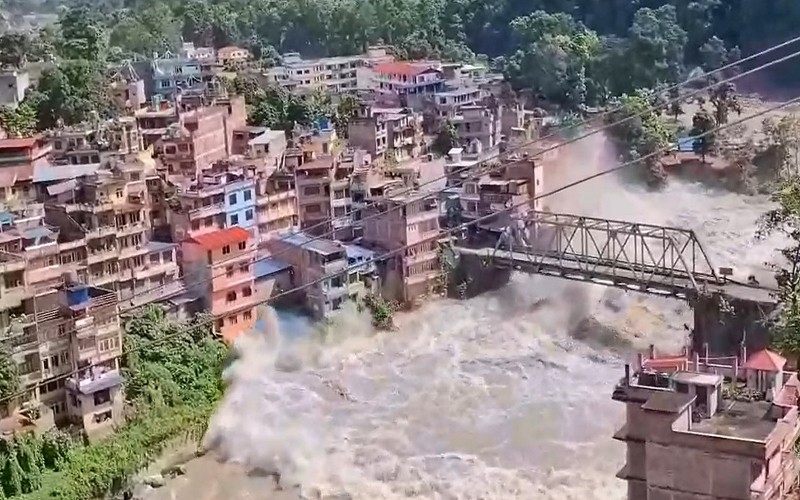
The disaster sent a sudden surge of water and debris into the Lhende River near Gyirong, close to the Nepal border.
The resulting floodwaters travelled downstream through the Bhote Koshi and Trishuli river systems, devastating communities and destroying roads, houses and power infrastructure.
Nepal has reported a rapidly rising death toll, while hundreds remain unaccounted for.
The scale of the disaster has prompted large-scale rescue operations on both sides of the Himalayan border.
Barrier lake raises concern over second flood
Chinese authorities have now identified a new geological hazard upstream from the worst-hit area.
According to CCTV, the Ministry of Water Resources has stepped up monitoring of a barrier lake located near the junction of the Chhochen Khola and Purepu Tsangpo rivers, northeast of the main disaster site.
The lake had an estimated volume of around 2 million cubic metres as of Thursday and was already overflowing.
Chinese authorities expect another 3 million cubic metres of water to enter the lake over the following three days.
The barrier lake's condition has raised concerns that a sudden breach could generate another surge of water and debris, potentially complicating rescue and relief operations already facing difficult terrain and damaged infrastructure.
China has warned that the lake could breach within 72 hours, according to reports citing Chinese authorities.
BREAKING: At least 380 people missing after flash flood hits near Nepal-Tibet border pic.twitter.com/iCRpXJaBAe
— BNO News Live (@BNODesk) August 26, 2026
558 missing in Tibet
CCTV reported that 558 people were missing in Tibet's Gyirong County following the disaster, including 260 foreign nationals.
Three people have been confirmed dead on the Chinese side, while two villagers have been rescued, according to Chinese state media.
Authorities have evacuated villages considered to be at risk from further flooding and geological instability.
China's Ministry of Foreign Affairs spokesperson Lin Jian separately said that nearly 100 Chinese citizens were missing on the Nepalese side of the border.
The number of missing people has continued to change as authorities on both sides expand search operations and receive information from families, tourists and local communities.
Nepal faces heavy loss of life
The disaster has caused an even greater loss of life in Nepal, where floodwaters swept through communities along the Bhote Koshi and Trishuli rivers.
Nepali authorities have reported hundreds of deaths and hundreds more missing.
The latest figures cited by international media put the number of missing people in Nepal at 826, while the death toll has risen sharply as rescuers recover more bodies.
The affected area is popular with tourists, trekkers and pilgrims travelling towards Tibet, including people heading towards Mount Kailash.
Among those reported missing are large numbers of foreign nationals.
Authorities have identified missing citizens from India, the United States, Australia, the United Kingdom, Canada and several other countries.
Devastating flash flood hits Nepal’s Rasuwa district 💔
— SUNITA (@SaffronSunita) August 26, 2026
Lives lost. Hundreds still missing including Indian tourists and Kailash pilgrims.
Bridges and roads washed away. Rescue teams working through the day.
May Mahadev protect everyone. 🙏#Nepal pic.twitter.com/7PlVpr2zNo
Mudslide triggered catastrophic flooding
The disaster began when a mass of mud, rock, ice and debris collapsed into a river near the border.
Verified footage showed a huge wall of water and debris sweeping through the Gyirong border area, while downstream floodwaters destroyed buildings, vehicles, roads and bridges.
Initial reports raised the possibility of an earthquake, but subsequent analysis by the US Geological Survey indicated that the event was caused by a glacial collapse and debris flow rather than an earthquake.
The sudden release of water and debris overwhelmed river channels and sent destructive flows downstream into Nepal.
Now, the death toll has risen to 359 people in Nepal’s devastating flash floods, while more than 1,300 remain missing as the search for survivors continues, police say. pic.twitter.com/Cfhkfb1btj
— Weather Monitor (@WeatherMonitors) August 27, 2026
China mobilises rescue teams
Chinese authorities have deployed additional emergency personnel to the affected areas.
Fire and rescue teams from Beijing and Chengdu have been sent to assist local police and armed forces with search-and-rescue operations.
Authorities have also intensified monitoring of the barrier lake to assess the possibility of a secondary disaster.
Electricity and communications have reportedly been restored in parts of central Gyirong town, although services connected to the border port remained disrupted.
Damage to roads and other infrastructure has made access to affected areas difficult.
A massive flash flood hit the 🇳🇵Nepal-Tibet border, damaging roads and bridges. 🚨
— Info Room (@InfoR00M) August 26, 2026
- Tragically, 8 people died, while 384 travelers including 105 Indian tourists—are missing. Intense rescue operations are underway. pic.twitter.com/HTMKbdpKYi
Himalayan region faces continuing flood risks
The latest disaster follows another major flood event in the Himalayan region last year.
In August 2025, a glacial lake in Tibet overflowed amid high temperatures, killing nine people and damaging critical infrastructure, including a bridge connecting Nepal and China.
The repeated disasters have highlighted the vulnerability of communities and infrastructure in the Himalayan region, where glacial and geological hazards can rapidly trigger flooding across national borders.
With the latest barrier lake already overflowing and more water expected to enter it, Chinese authorities are continuing to monitor the site as rescue teams search for those still missing from the devastating floods.
Support Our Journalism
We cannot do without you.. your contribution supports unbiased journalism
IBNS is not driven by any ism- not wokeism, not racism, not skewed secularism, not hyper right-wing or left liberal ideals, nor by any hardline religious beliefs or hyper nationalism. We want to serve you good old objective news, as they are. We do not judge or preach. We let people decide for themselves. We only try to present factual and well-sourced news.
Support objective journalism for a small contribution.


