


 BRICS
BRICS
BRICS Summit: Guterres says global institutions are outdated, calls for major reform
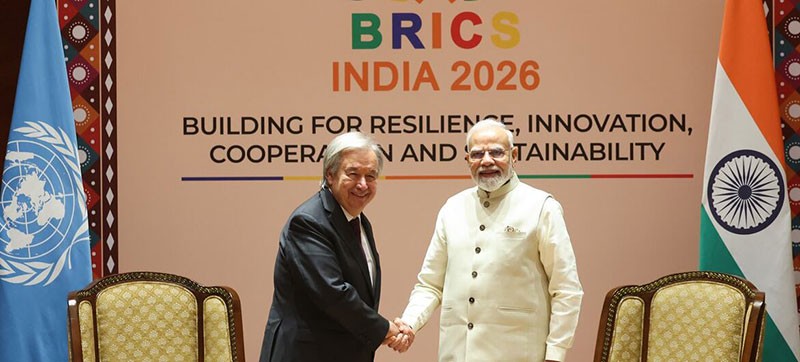
UN Secretary-General António Guterres told BRICS leaders in New Delhi on Sunday that creating a more balanced global order requires an overhaul of institutions established after the Second World War, including the UN Security Council.
The BRICS grouping — originally comprising Brazil, Russia, India, China and South Africa and now expanded to include several other countries — was established to give major developing economies a stronger voice in a global system long dominated by Western powers.
This year’s summit, hosted by India, has brought together heads of state as well as leaders of the World Health Organization (WHO) and the World Trade Organization (WTO).
‘Reflecting reality’
“Today’s economic, demographic and geopolitical realities are not those of 1945,” Guterres said. “Our institutional structures must reflect it.”
He told the assembled leaders that their presence at the summit itself reflected the changing global order.
“Countries represented at this Summit speak to that changing reality,” he said, adding that “we are increasingly moving towards a multipolar world.”
Guterres said the shift should be embraced rather than resisted.
“Multipolarity helps bring balance and equity to global systems and institutions,” he said, while calling for reforms to bodies including the UN Security Council and the Bretton Woods institutions to ensure they better reflect the world of today.
Four priorities for global growth
Guterres outlined four priorities for what he described as “inclusive global growth”: financing, technology, climate justice and peace.
On financing, he said developing countries “need massive international support” to achieve the Sustainable Development Goals, and called for multilateral development banks to become “bigger, better and bolder.”
On artificial intelligence, Guterres warned that the benefits of the technology remain concentrated.
“Its power sits with a few companies, in a few countries,” he said. “Unchecked, the AI divide will widen every other divide — in income, in opportunity, in security, and in sovereignty.”
His strongest warning came on climate change. Pointing to extreme heat, melting glaciers, wildfires and floods, Guterres said these events were “a preview” of what lies ahead.
He also warned that a “supersized El Niño” could worsen the situation as the world approaches the 1.5-degree Celsius threshold above pre-industrial levels.
Guterres urged wealthy nations to honour existing climate finance commitments, including $300 billion a year, increased adaptation finance and greater funding for loss and damage.
He also criticised the exploitation of critical minerals, saying: “Enough plundering.”
Calls for peace and security
On global peace and security, Guterres highlighted conflicts and crises in Gaza, the wider Middle East, Ukraine and Sudan.
He called on countries to uphold the principles of the UN Charter, including sovereign equality, territorial integrity and the peaceful settlement of disputes.
‘Collective responsibility’
Guterres concluded by presenting reform of the international system as a shared responsibility rather than a concession to developing countries.
“As we move irreversibly to a multipolar world, all countries must work to strengthen and safeguard a multilateral system that delivers for all with the United Nations at its centre,” he said.
Support Our Journalism
We cannot do without you.. your contribution supports unbiased journalism
IBNS is not driven by any ism- not wokeism, not racism, not skewed secularism, not hyper right-wing or left liberal ideals, nor by any hardline religious beliefs or hyper nationalism. We want to serve you good old objective news, as they are. We do not judge or preach. We let people decide for themselves. We only try to present factual and well-sourced news.
Support objective journalism for a small contribution.


