


 Bangladesh
Bangladesh votes for first time since Hasina’s ouster — Why India is watching closely
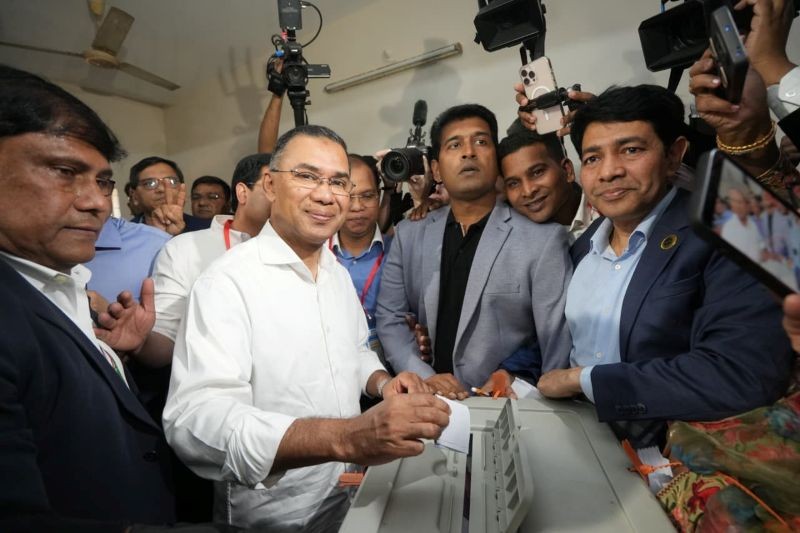
Dhaka/New Delhi/IBNS: Bangladesh went to polls on Monday succeeding the ouster of Sheikh Hasina and the turbulent phase of interim governance under Nobel Laureate Muhammad Yunus.
The elections are being held six months less than two years after Hasina fled the country and took refuge in India after the anti-quota stir turned violent and threatened the then Prime Minister's security.
With Hasina's Awami League not in the fray and Khaleda Zia's death, the two giant politicians are not in the electoral battle for the first time in 30 years.
Bangladesh Nationalist Party (BNP), which is currently headed by Zia's son Tarique Rahman, is aiming to return to power while
Rahman returned to the country in the recent past after an exile for 17 years in London.
For nearly 15 years, New Delhi enjoyed close ties with Hasina’s Awami League government. Her departure and the reshaping of Bangladesh’s political landscape introduce a new layer of uncertainty in a relationship India considers fundamental to its regional strategy.
A 4,096 km Security Imperative
India shares its longest land border — 4,096 km — with Bangladesh. Stability in Dhaka directly influences internal security in India’s eastern and northeastern states.
Under Hasina, cooperation between the two sides significantly reduced insurgent safe havens and strengthened counter-terror coordination. Intelligence-sharing mechanisms were institutionalised, and cross-border militancy declined sharply.
Any dilution of this security architecture under a new political dispensation could complicate India’s internal security matrix, particularly in Assam, Tripura and Meghalaya. Border management, migration flows and trafficking networks remain sensitive issues that require sustained bilateral cooperation.
Gateway to the Northeast
Bangladesh is central to India’s connectivity ambitions. Geographically, it acts as the natural bridge between mainland India and the landlocked Northeast.
India relies on Bangladeshi ports, inland waterways, rail links and road corridors to transport goods to Tripura, Assam and other northeastern states. These connectivity projects are not merely economic initiatives; they form the backbone of New Delhi’s Act East policy, aimed at integrating the Northeast with Southeast Asia.
A politically unstable or less cooperative government in Dhaka could slow infrastructure projects, complicate transit arrangements and weaken India’s regional connectivity strategy.
The China Calculus
Perhaps the most significant long-term concern for India is China’s expanding footprint in Bangladesh.
Beijing has invested heavily in infrastructure, energy, port development and defence cooperation. Bangladesh is also a participant in China’s Belt and Road Initiative (BRI), placing it within Beijing’s broader maritime and strategic network in the Bay of Bengal.
For India, the Bay of Bengal is a critical maritime space linked to its eastern naval command and Indo-Pacific strategy. A government in Dhaka that tilts decisively toward Beijing could expand China’s strategic leverage in India’s immediate neighbourhood, intensifying competition in the Indian Ocean region.
Economic Interdependence
Bangladesh is India’s largest trade partner in South Asia, with bilateral trade exceeding $15 billion. India exports electricity, refined fuel and essential commodities, while Bangladeshi industries — particularly textiles — remain deeply integrated with Indian supply chains.
Political continuity ensures predictable trade flows, energy cooperation and industrial collaboration. Instability, however, could disrupt economic momentum and undermine regional integration efforts.
Domestic Political Ripple Effects
Developments in Bangladesh often resonate within India’s domestic politics, particularly in border states such as West Bengal and Assam.
Migration, citizenship debates and communal narratives can quickly acquire electoral overtones. A volatile situation in Bangladesh has the potential to inflame domestic discourse in India, making the election outcome politically consequential beyond foreign policy circles.
A Test of India’s Regional Diplomacy
Over the past decade, Bangladesh has been one of India’s most successful diplomatic partnerships in South Asia. The relationship symbolised New Delhi’s ability to stabilise and deepen ties in its immediate neighbourhood.
A shift in Dhaka’s political orientation would not automatically reverse bilateral gains, but it would test India’s diplomatic agility. Managing ties with a potentially more diverse or ideologically different leadership will require recalibration.
Support Our Journalism
We cannot do without you.. your contribution supports unbiased journalism
IBNS is not driven by any ism- not wokeism, not racism, not skewed secularism, not hyper right-wing or left liberal ideals, nor by any hardline religious beliefs or hyper nationalism. We want to serve you good old objective news, as they are. We do not judge or preach. We let people decide for themselves. We only try to present factual and well-sourced news.
Support objective journalism for a small contribution.


