


Absence of 'credible political solution' causing severe consequences in Middle East: UN chief
“As we have seen with the recent devastation in the Gaza Strip and rising tensions and violence in the West Bank, including East Jerusalem, it is becoming increasingly difficult to contain the situation,” said Ban at a United Nations high-level meeting on the situation in the Middle East.
The Ad Hoc Liaison Committee (AHLC) meeting, convened by Norway, is taking place against the backdrop of an “extremely challenging and volatile situation on the ground,” said the UN chief.
Joining the Secretary General were Prime Minister Rami Hamdallah of the State of Palestine, Foreign Minister Børge Brende of Norway, United States Secretary of State John Kerry, and Deputy Foreign Minister Tzachi Hanegbi of Israel.
Ban said he hoped on Monday’s deliberation would help ensure support for the Palestinian Authority’s (PA) state-building and development objectives, while strengthening Israeli-Palestinian economic cooperation. Peace talks between Israel and the PA were suspended in April.
“Any peace effort that does not tackle the root causes of the crisis will do little more than set the stage for the next cycle of violence,” said the Secretary-General.
The UN estimates last summer’s wave of violence killed 2,101 Palestinians and 67 Israelis, in addition to forcing 475,000 Palestinians to seek refuge at UN facilities inside Gaza.
At the meeting on Monday, Ban reiterated his call that the closure of Gaza must end while addressing Israel's legitimate security concerns. Gaza must now be opened up for reconstruction and recovery to address the unprecedented destruction. The open-ended ceasefire for Gaza, brokered under Egyptian auspices, could serve as a prelude to a political process as the only way of achieving durable peace.
“It is time for sustainable, transformational change in the Gaza Strip. Gaza and the West Bank must be brought back under the effective authority of one legitimate Palestinian Government that adheres to the PLO commitments,” said Ban.
Nevertheless, there are some real challenges ahead for the Government of National Consensus in this regard which may require support and the United Nations stands ready to support efforts to address the structural factors of conflict between Israel and Gaza.
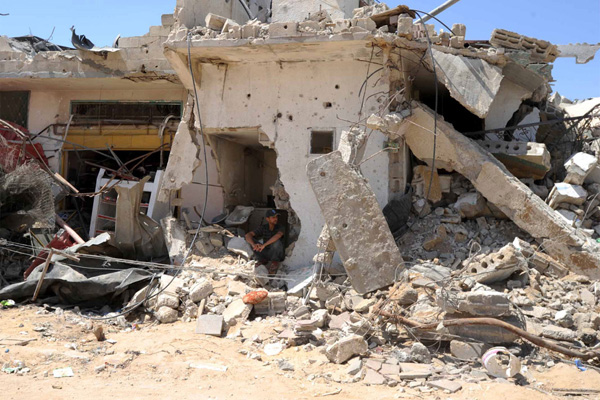
“The current situation in Gaza is dire, with many people still displaced, unprecedented damage to social and economic infrastructure, and critical shortages of water and energy,” Ban said, welcoming the agreement between Israel, the Palestinian Authority and UN on the secure entry of construction materials into Gaza.
“The cycle of building and destroying must end. It is time for sustainable, transformational change in the Gaza Strip,” said Ban.
The planned reconstruction conference co-sponsored by Egypt and Norway, to be held on 12 October in Cairo is an opportunity to pay special attention to the development of the West Bank, fiscal sustainability for the PA and economic viability for Palestine, he added.
Such positive measures are mutually reinforcing, would result in tangible benefits on the ground and foster badly needed trust. But all of these efforts must be put into a credible political framework, Ban said.
Both sides must restore prospects for a two-state solution by returning to meaningful negotiations towards a final status agreement that fulfills the aspirations of Israelis and Palestinians. That includes an end to the occupation that began in 1967, for Israel to live within secure and recognized borders, and for an independent State of Palestine living alongside Israel in peace and prosperity.
Established in October 1993, the Ad Hoc Liaison Committee is a 15-member committee that seeks to promote dialogue between donors, the Palestinian Authority and the Government of Israel. The body is chaired by Norway and co-sponsored by the European Union and United States.
UNRWA estimates around 17,000 destroyed or damaged homes, rendering 100,000 people homeless in Gaza. Photo: UNRWA Archives/Shareef Sarhan
Support Our Journalism
We cannot do without you.. your contribution supports unbiased journalism
IBNS is not driven by any ism- not wokeism, not racism, not skewed secularism, not hyper right-wing or left liberal ideals, nor by any hardline religious beliefs or hyper nationalism. We want to serve you good old objective news, as they are. We do not judge or preach. We let people decide for themselves. We only try to present factual and well-sourced news.
Support objective journalism for a small contribution.


