

Sharjeel Imam’s explosive thesis: Congress and Hindutva are alike, Gandhi was a fascist — and ‘cut off’ the Northeast
Sharjeel Imam, a former JNU scholar and activist, remains in Tihar Jail in the larger-conspiracy case linked to the February 2020 North-East Delhi riots, which killed 53 people. Arrested in January 2020, he faces charges under the Unlawful Activities (Prevention) Act (UAPA) over alleged involvement in a conspiracy behind the violence that erupted amid protests against the Citizenship Amendment Act (CAA). Imam denies the allegations, and the case remains pending trial. From challenging the Constitution and revisiting Partition to advocating a blockade of the Northeast, jailed activist Sharjeel Imam ’s views put him at odds with the very existence of India’s mainstream secular and nationalist traditions.
Sharjeel Imam has reopened a contentious debate over India’s Constitution, secularism and national identity with a series of arguments that challenge the country’s mainstream liberal and secular traditions.
In a September 29 interview with The Quint, the former JNU research scholar argued that Congress-led secularism and Hindutva share a centralising vision of India, challenged conventional accounts of Mahatma Gandhi and Jawaharlal Nehru, and questioned whether the Constitution adequately protects Muslims.
His views have gained renewed attention following critical opinion pieces in ThePrint questioning the silence of the liberals on his views. But the controversy surrounding Imam predates these arguments: his January 2020 call to blockade routes connecting the Northeast with the rest of India remains among his most contentious public statements.
Sharjeel Imam, born in 1988 in Kako village in Bihar’s Jehanabad district, is a former JNU research scholar and IIT Bombay computer engineering graduate. He is the son of the late Akbar Imam, a former Janata Dal (United) politician who unsuccessfully contested the 2005 Bihar Assembly election, and his mother, Afshan Rahim, is a homemaker.
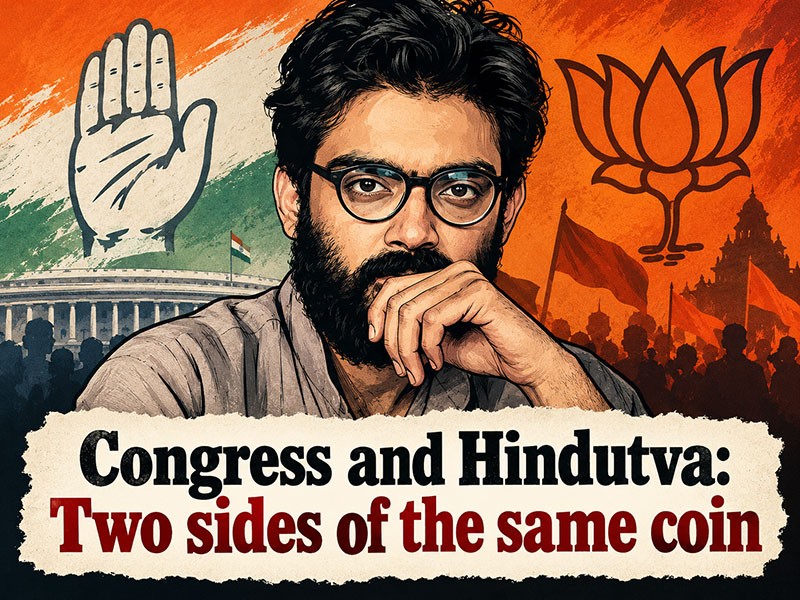
Congress and Hindutva: Two sides of the same coin?
Imam argues that Congress and the BJP, despite their ideological differences, operate within a political framework that concentrates power at the Centre and leaves Muslims with inadequate political representation.
He accuses Congress of discouraging independent Muslim political assertion by expecting minorities to vote for secular parties primarily to keep the BJP out of power.
His contention is that replacing the BJP with Congress would offer temporary relief without addressing what he considers the structural exclusion of Muslims.
Imam thus challenges not merely particular governments but the common national identity underpinning the Indian Republic. His critics counter that equating Congress-led secularism with Hindutva overlooks substantial differences in their political programmes and approaches to minorities.
Gandhi a fascist? His attack on the Mahatma
Imam has previously described Mahatma Gandhi as the “biggest fascist of the 20th century”, a remark reported in connection with his January 2020 speech at Aligarh Muslim University.
His criticism centres on Gandhi’s vision of Indian nationalism, including the concept of Ram Rajya, and what Imam sees as Congress leaders’ failure to accommodate Muslim political demands.
He also challenges the idealisation of Gandhi and Nehru in mainstream accounts of India’s freedom struggle.
The description of Gandhi as a fascist is Imam’s political characterisation, not an established historical consensus. Critics argue that it overlooks Gandhi’s opposition to communal hatred and his role in the independence movement.
‘Cut off’ the Northeast: The speech that triggered a national storm
Imam’s most controversial public remarks date to January 16, 2020, when he addressed an anti-CAA protest at Aligarh Muslim University.
He called for blockading transport routes connecting the Northeast with the rest of India, particularly the strategically important Siliguri Corridor, to pressure the government over the Citizenship Amendment Act and the proposed National Register of Citizens.
He spoke of cutting off Assam and disrupting the connection between the Northeast and the rest of the country. Imam subsequently described his proposal as a peaceful chakka jam. Nevertheless, deliberately obstructing this critical corridor raised serious concerns because of its importance to Assam and the wider Northeast.
"Agar hamaare paas 5 Lakhs log ho to hum Northeast ko permanently cut kar sakte hai. Assam ko kaatna hamaari jimmedari hai." Translated to English he said: “If we have 500,000 people, we can permanently cut off the Northeast. It is our responsibility to cut off Assam.”
The speech led to police cases in multiple states and became central to the controversy surrounding his political activities. The stated context of protest should be distinguished from any claim that he intended permanent territorial separation; the specific blockade proposal, however, remains a central part of the record.
“We will create a crowd where even non-Muslims will chant ‘Allahu Akbar’ alongside us. If they refuse to accept our conditions, we will consider them unsympathetic to our cause. We have a crowd of 500,000 people, and we can cut off the Northeast from India." — Sharjeel Imam https://t.co/3ka7Dnt3Nr
— _sumit (@_summitt) October 22, 2026
The Constitution is the problem, says Imam
In his latest interview, Imam argues that the Constitution itself is a roadblock to the dignified existence of Muslims and other religious minorities. He rejects the campaign to “Save the Constitution”, contending that its centralising structure and electoral arrangements require fundamental change.
He advocates proportional representation, decentralisation, autonomous community institutions and reservations for Muslims, including disadvantaged Dalit Muslims and Christians.
His argument is that formal equality does not necessarily translate into adequate political power for minorities.
The contentious question is whether community-specific political arrangements would strengthen minority protection or weaken the principle of equal citizenship within a common constitutional framework.
Partition: Congress, not just the Muslim League, under scrutiny
Imam disputes conventional accounts that place primary responsibility for Partition on the Muslim League’s separatist politics.
He argues that Congress leaders rejected the Cabinet Mission Plan of 1946 because they preferred a strong Centre, helping make Partition inevitable. He presents Muhammad Ali Jinnah as an important democratic leader of pre-Partition Indian Muslims and argues that demands for political safeguards should not simply be dismissed as separatism.
His interpretation places substantial responsibility on Congress’s unwillingness to accept a decentralised arrangement.
The collapse of the Cabinet Mission Plan involved competing positions among Congress, the Muslim League and other political forces. Imam’s account remains a contested interpretation of a complex historical process.
Muslims, Islam and political power
Imam calls for an independent political programme for Muslims rather than unquestioning dependence on Congress or other secular parties.
His proposals include proportional representation, greater community autonomy and alliances with Dalits, tribals and other marginalised groups.
He also draws on Islamic concepts to frame his understanding of justice, equality and resistance to oppression. He argues that Muslims should not have to subordinate their religious identity to a uniform national identity to claim political rights.
Critics say this approach risks making religious identity the organising principle of politics rather than treating citizens primarily as equal individuals entitled to the same rights and responsibilities.
Sources: The Quint interview, September 29, 2026; ThePrint opinion articles published in October 2026; contemporary reporting on Imam’s January 2020 AMU speech.
Support Our Journalism
We cannot do without you.. your contribution supports unbiased journalism
IBNS is not driven by any ism- not wokeism, not racism, not skewed secularism, not hyper right-wing or left liberal ideals, nor by any hardline religious beliefs or hyper nationalism. We want to serve you good old objective news, as they are. We do not judge or preach. We let people decide for themselves. We only try to present factual and well-sourced news.
Support objective journalism for a small contribution.