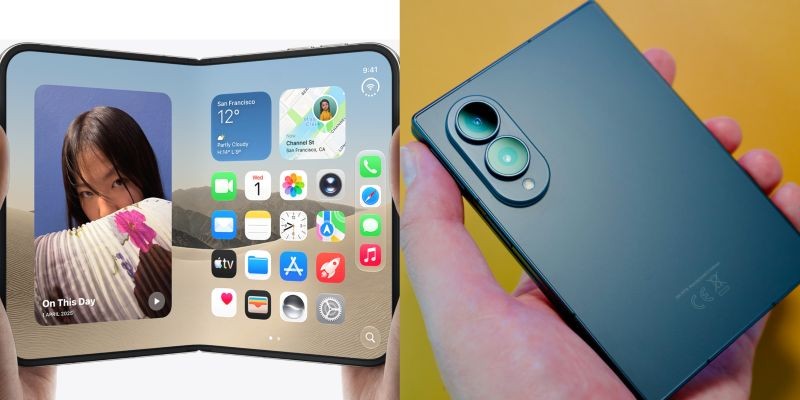
iPhone Duo vs Galaxy Z Fold8: Apple’s first foldable takes on Samsung
Apple has entered the foldable smartphone market with the launch of the iPhone Duo, taking on established players such as Samsung, which has already built several generations of foldable devices.
The iPhone Duo arrives as a direct rival to Samsung's Galaxy Z Fold8, offering a book-style foldable design, a large inner display and flagship-level hardware. However, the two devices differ significantly in price, weight, cameras and software.
Price: Apple is significantly more expensive
In India, the iPhone Duo starts at ₹2,99,900 for the 256GB model and is available with storage options going up to 2TB.
The Galaxy Z Fold8, meanwhile, starts at a considerably lower price for its 256GB variant. This gives Samsung a major advantage for consumers looking for a premium foldable without crossing the ₹2 lakh mark.
The price difference could become one of the biggest factors for Indian buyers deciding between the two devices.
Display and design
The iPhone Duo features a 7.6-inch folding inner OLED display and a 5.4-inch outer display. Both displays support ProMotion with adaptive refresh rates of up to 120Hz.
Apple has used a titanium foldable design, with the device measuring just 5.2mm when unfolded and weighing 254 grams.
Samsung's Galaxy Z Fold8 also features a 7.6-inch main display, while its cover screen measures 5.5 inches. The device weighs just 201 grams, making it significantly lighter than Apple's foldable.
Samsung's Fold8 also measures 4.5mm at its thinnest point when unfolded, giving it an advantage in portability.
Performance
The iPhone Duo is powered by Apple's A20 Pro chip, which is designed to deliver improved performance, graphics and on-device AI capabilities.
The Galaxy Z Fold8 is powered by the Snapdragon 8 Elite Gen 5 for Galaxy, with a dedicated NPU, GPU and CPU designed to handle demanding applications and Galaxy AI features.
Both phones are therefore positioned as high-performance devices, although they take different approaches to hardware and AI, with Apple relying on its own silicon and ecosystem and Samsung using Qualcomm's customised flagship processor.
Camera
Apple has equipped the iPhone Duo with a 48MP Dual Fusion camera system, including a 48MP main camera and a 48MP ultra-wide camera.
The device also features an under-display FaceTime camera and supports 4K Dolby Vision video recording.
Samsung's Galaxy Z Fold8 features dual 50MP rear cameras, covering wide and ultra-wide photography, along with 10MP cameras on both the cover and main displays. Samsung also supports 8K video recording on the Fold8.
Battery and charging
The iPhone Duo uses dual built-in batteries and is rated for up to 24 hours of typical use. Apple says the device can reach up to 50% charge in around 20 minutes with a 60W-capable adapter.
The Galaxy Z Fold8 packs a 4,800mAh battery and is rated for up to 26 hours of video playback.
AI and software
The iPhone Duo runs on iOS 27 and brings Apple's next-generation Apple Intelligence features, including an upgraded Siri AI designed to work more deeply across apps.
Samsung's Galaxy Z Fold8 runs Android with Samsung's Galaxy AI features, including tools designed around productivity, photography and multitasking.
The software experience could therefore be a major deciding factor: iPhone users are likely to favour Apple's ecosystem and iOS experience, while Samsung offers the flexibility of Android and its mature foldable-focused multitasking features.
So, which foldable wins?
The answer largely depends on what the buyer values.
The iPhone Duo brings Apple's ecosystem, A20 Pro performance, a titanium design, up to 2TB storage and Apple's first major push into foldables. But at ₹2,99,900, it comes at a substantial premium.
The Galaxy Z Fold8, on the other hand, is considerably lighter at 201 grams, offers a 7.6-inch inner display, a 5.5-inch cover display, dual 50MP rear cameras and a more established foldable experience.
For buyers who want the Apple ecosystem and are willing to pay a premium, the iPhone Duo could be the more attractive option.
For those looking for a lighter foldable with a lower entry price and Samsung's years of experience in the category, the Galaxy Z Fold8 has a clear advantage.
Apple's entry nevertheless changes the foldable smartphone market significantly.
Samsung introduced its first Galaxy Fold in 2019 and has since developed multiple generations of foldable devices. Apple's arrival could intensify competition in the premium foldable segment and potentially bring the form factor to a much wider audience.
Support Our Journalism
We cannot do without you.. your contribution supports unbiased journalism
IBNS is not driven by any ism- not wokeism, not racism, not skewed secularism, not hyper right-wing or left liberal ideals, nor by any hardline religious beliefs or hyper nationalism. We want to serve you good old objective news, as they are. We do not judge or preach. We let people decide for themselves. We only try to present factual and well-sourced news.
Support objective journalism for a small contribution.