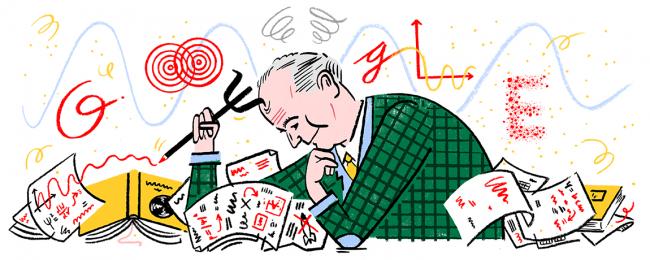
Google doodles on German physicist Max Born's 135th birth anniversary
New York, Dec 11 (IBNS): Popular search engine Google on Monday decorated its homepage with a doodle to mark German physicist and mathematician Max Born's 135th birth anniversary.
"Today's Doodle celebrates the 135th birthday of Max Born, German physicist and mathematician who was awarded the Nobel Prize for his contribution to the field of quantum mechanics," read the Google website as it spoke on the doodle.
An outstanding student, Born earned his Ph.D. at Göttingen University where he later became a professor of theoretical physics, collaborating with and mentoring some of the most famous scientists of the time.
In 1933 he was forced to flee Germany for England, where he served as the Tait Professor of Natural Philosophy at the University of Edinburgh for nearly two decades until his retirement in 1954 when he returned home to Göttingen.
Born was awarded the Nobel Prize in 1954 for the Born Rule — a quantum theory that uses mathematical probability to predict the location of wave particles in a quantum system.
Support Our Journalism
We cannot do without you.. your contribution supports unbiased journalism
IBNS is not driven by any ism- not wokeism, not racism, not skewed secularism, not hyper right-wing or left liberal ideals, nor by any hardline religious beliefs or hyper nationalism. We want to serve you good old objective news, as they are. We do not judge or preach. We let people decide for themselves. We only try to present factual and well-sourced news.
Support objective journalism for a small contribution.