Bollywood needs to rethink Dalit representation, media scholar says
As he begins the first study of its kind in 40 years, Vishal Chauhan, from Ajmer in Rajasthan, is highlighting the representation of marginalised people in Indian cinema, and says that their stereotyped depictions on screen are fuelling further social stratification.
Dalit, meaning ‘thrashing’ or ‘pressing’ in Sanskrit and ‘broken’ or ‘oppressed’ in Hindi, is a term for the members of lower castes in India. In popular Indian cinema Dalits are traditionally portrayed as ill-dressed, under confident and ugly. Furthermore, characters from lower castes are rarely played by Dalit actors, instead, they are performed by upper caste actors donning blackface.
Vishal Chauhan, PhD researcher, Birmingham City University, said: “Dalits represent around 22 per cent of India’s population, yet they do not receive equal screen time compared with other societal groups. For example, a recent analysis of lead characters of more than 250 films released in 2013 and 2014 by ‘The Hindu’ newspaper revealed that only six lead characters belonged to a lower caste."
“Where filmmakers have attempted to honestly portray Dalits, their films tend to be labelled as an art house picture and receive a limited release. In big budget films, Dalits will more than likely be played by higher caste actors, and lower caste peoples are barely reflected in positions behind the camera either," he said.
“Most worrying, however, is the stereotypical portrayal of Dalit peoples – when they do appear – as intellectual inferior and only able to survive on the good will of upper caste peoples. The Indian film industry has helped create an untrue perception of an entire community,” he said.
The Indian caste system originates as far back as 1500 BC and, despite the practice of untouchability being constitutionally abolished in 1950, the hierarchy and social ostracisation continues and, in many cases, is getting worse, particularly in rural India. According to the National Crime Records Bureau (NCRB), crimes against Dalits increased by 29 percent from 2012 to 2014.
Vishal’s investigation forms part of his PhD studies at Birmingham City University, and he hopes his findings can be used to inform Bollywood and Indian policymakers of the importance of normalising Dalit representation on screen and taking positive action in order to make this happen.
His research will centre on 15 Hindi films from the 1930s to the 2010s, and will consider such features as ‘Sujata’ (Roy, 1959) and ‘Aarakshan’ (Jha, 2011). Rather than simply relying on textual analysis, Vishal will engage with archives at the Film and Television Institute of India (FTII) in Pune and contemporary documents, to better understand the context within which cinemagoers reacted to these films when originally released and how people from lowers castes were represented.
The Indian academic has chosen to undertake this study in the UK, because he feels that his study is not ready to be accepted as a question within India itself.
Vishal is being supervised in Birmingham School of Media at the University by Professor Rajinder Dudrah, who is one of the leading scholars of Indian cinema studies in the UK.
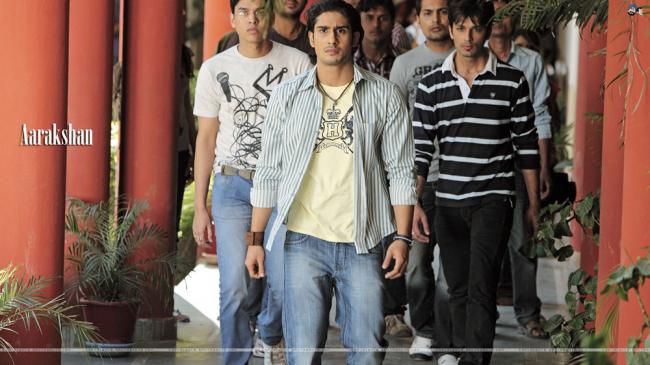
Image from the movie Aarakshan: Santabanta.com
Support Our Journalism
We cannot do without you.. your contribution supports unbiased journalism
IBNS is not driven by any ism- not wokeism, not racism, not skewed secularism, not hyper right-wing or left liberal ideals, nor by any hardline religious beliefs or hyper nationalism. We want to serve you good old objective news, as they are. We do not judge or preach. We let people decide for themselves. We only try to present factual and well-sourced news.
Support objective journalism for a small contribution.