


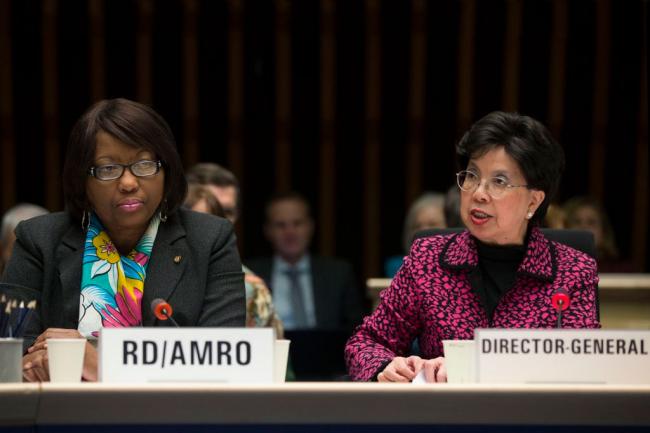
WHO convenes emergency meeting to address 'dramatic' spread of Zika virus
“The level of alarm is extremely high,” WHO Director-General Margaret Chan told her Executive Board in Geneva, noting that for decades the disease, transmitted by the Aedes genus of mosquito, “slumbered,” affecting mainly monkeys and occasionally causing a mild disease of low concern in humans.
“The situation today is dramatically different. Last year, the virus was detected in the Americas, where it is now spreading explosively. As of today, cases have been reported in 23 countries and territories in the region,” she added in convening an Emergency Committee under the International Health Regulations on the epidemic.
The virus, first reported by Brazil in May, is expected to spread to other parts of the world where dengue, spread by the same mosquito, is also present, said Marcos Espinal, Director of the Department of Communicable Diseases and Health Analysis at the Pan American Health Organization (PAHO), WHO’s regional branch.
He told the Board he expects the outbreak, already linked to some 4,000 births of babies with abnormally small heads, a condition known as microcephaly, to grow from current estimates of one million cases to possibly three million to four million before it can be brought under control.
“We should not panic,” he stressed. “We should not be afraid, but we need to try and have aggressive vector control in the affected countries,” he stressed.
Dr. Chan noted that there is a high level of uncertainty. “Questions abound,” she said. “We need to get some answers quickly. I am asking the Committee for advice on the appropriate level of international concern and for recommended measures that should be undertaken in affected countries and elsewhere. I will also ask the Committee to prioritize areas where research is most urgently needed.”
In some places the virus has been associated with a steep increase in microcephaly and with the sometimes fatal Guillain-Barre syndrome, but a causal relationship with Zika has not yet been established although it is strongly suspected, she added.
“The possible links, only recently suspected, have rapidly changed the risk profile of Zika, from a mild threat to one of alarming proportions. The increased incidence of microcephaly is particularly alarming, as it places a heart-breaking burden on families and communities. WHO is deeply concerned about this rapidly evolving situation.”
She also warned of the potential for Zika to spread even further internationally given the wide geographical distribution of the mosquito vector, and cited the lack of population immunity in newly affected areas and the absence of vaccines, specific treatments, and rapid diagnostic tests.
Moreover, conditions associated with this year's El Niño weather pattern, which causes droughts in parts of the world and floods in others, are expected to increase mosquito populations greatly in many areas.
Photo: WHO/C. Black/www.justearthnews.com
Support Our Journalism
We cannot do without you.. your contribution supports unbiased journalism
IBNS is not driven by any ism- not wokeism, not racism, not skewed secularism, not hyper right-wing or left liberal ideals, nor by any hardline religious beliefs or hyper nationalism. We want to serve you good old objective news, as they are. We do not judge or preach. We let people decide for themselves. We only try to present factual and well-sourced news.
Support objective journalism for a small contribution.


