


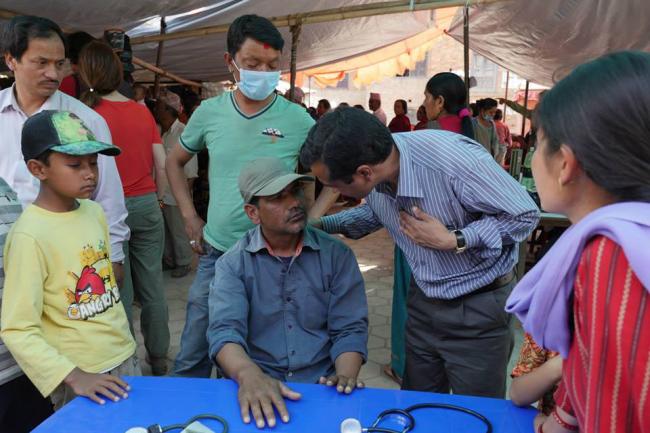
UN guide aims to address mental health needs in humanitarian emergencies
“We call upon all humanitarian partners in the health sector to adopt and disseminate this important guide, to help reduce suffering and increase the ability of adults and children with mental health needs to cope in humanitarian emergency settings,” said Dr. Margaret Chan, Director General of the World Health Organization (WHO) and Antonio Guterres, High Commissioner for Refugees (UNHCR) in the new guide’s forward.
According to the guide, worldwide close to 80 million people are impacted by humanitarian emergencies arising from natural disasters and armed conflicts, such as those in the Central African Republic, South Sudan, Syria, Yemen, and more recently, Nepal.
WHO said it estimates 5 to 10 per cent of these people suffer from a mental health condition such as depression as a result of the emergency but “rarely have access to specialized health workers trained in assessing and managing their conditions.”
Dr. Mark Van Ommeren, WHO specialist on mental health in emergencies, told reporters in Geneva that the guide is important because the rates of mental discordance during emergencies had increased and also because when people are experiencing emergencies, they usually live far away from specialists.
The new Mental Health Gap Humanitarian Intervention Guide is aimed at non-specialist health workers so that they can better identify, assess and manage mental health needs.
Contents include modules on assessing and managing such conditions as acute stress, grief, moderate-severe depressive disorder, post-traumatic stress disorder, epilepsy, and harmful use of alcohol and drugs.
In emergencies, most people, adults and children, experience grief and acute distress, but “emergencies also trigger conditions such as depressive disorder, post-traumatic stress disorder or prolonged grief disorder, that can severely undermine a person’s daily functioning,” according WHO.
Mental health expert Dr. Pieter Ventevogel, of UNHCR noted that promoting and preserving mental health and psycho-social well-being was part of the agency’s mandate but often it was difficult to put it in practice for several reasons, including the refugee mental situations and the reduced number of mental health professionals available in the area.
“The Guide is the tool which will enable general health workers to identify and manage the most important mental health issues in refugee settings,” Dr. Ventevogel said.
He said, “All the health agencies in emergencies [have been] called on to train their staff in the use of that tool and include mental health as part of the standard mental package.”
WHO said the new guide will be used in Syria, where the four-year conflict has displaced more than 7.6 million people within the country and left an additional 4 million seeking refuge in neighbouring countries.
Photo: WHO/A. Bhatiasevi
Support Our Journalism
We cannot do without you.. your contribution supports unbiased journalism
IBNS is not driven by any ism- not wokeism, not racism, not skewed secularism, not hyper right-wing or left liberal ideals, nor by any hardline religious beliefs or hyper nationalism. We want to serve you good old objective news, as they are. We do not judge or preach. We let people decide for themselves. We only try to present factual and well-sourced news.
Support objective journalism for a small contribution.


