


 Afghanistan
UN commits to long-term support for Afghan mothers and newborns: Najaba’s story
New York: The delivery of reproductive health services, including safe childbirth, has been seriously impacted in Afghanistan, due to the turmoil surrounding the Taliban takeover of the country. Najaba, 36, has experienced firsthand how the dangers of pregnancy, collided with rising insecurity, according to the UN reproductive and maternal health agency, UNFPA, which continues to provide lifesaving services on the ground.
A mother of four from Zaradnay Village, she visited the district hospital just before her due date on 17 August, to check on the progress of her pregnancy.
An ultrasound revealed that the fetus was in a transverse position, meaning it was lying horizontally rather than head-down, a dangerous complication.
Concerns over Caesarean
The doctor told her she needed a Caesarean section, but Najaba was fearful of the operation. She left the hospital to give more thought to her situation.
She even considered trying to deliver at home. “When the district hospital discharged me, I decided to do the delivery at home with support of my mother,” Najaba told UNFPA.
But in the following days, growing insecurity caused many health facilities to close – including the district hospital.
Najaba realized that if the delivery proved complicated, she would be unable to seek emergency assistance.
Desperate search for care
She called her mother in desperation. Her mother called many of the women elders in their community to seek advice. Finally, Najaba recalled, “My relative called me and informed me about a small clinic.”
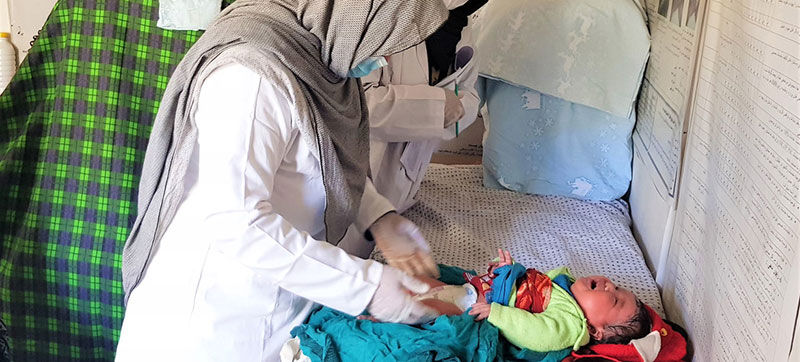
It was the nearby Ghuchan Family Health House, a UNFPA-supported facility where a community midwife was still providing services to pregnant women.
Going into labour
Not long after, Najaba went into labour. With her mother and husband, she rushed to the family health house. There, the midwife took her medical history, conducted a physical examination and listened to her concerns.
When Najaba expressed anxiety about the delivery, the midwife comforted her and said she would try to deliver the baby without any surgical procedure.
Four hours later, a healthy baby was born naturally.
The skilled midwife had been able to avoid a Caesarean section, and Najaba and the baby were both healthy enough to be discharged soon after.
Keeping doors open
Najaba was relieved to safely welcome her fifth baby, and her family was overjoyed. Najaba returned to the midwife for postnatal care and neonatal services for the baby.
She and her family say they plan to recommend the family health house to all pregnant women who they may meet in the future.
The family health house, located in Shahristan district in eastern Daikundi Province, provides life-saving reproductive, maternal, newborn and child health services.
It is one of 172 family health houses in geographically remote villages where people have little access to health services.
With support from UNFPA and local communities, these facilities have been able to continue operating, or to reopen after a short closure, even amid the ongoing security situation.
Services include prenatal care, safe delivery, antenatal care, family planning, nutrition services and integrated management of childhood illnesses services to children under five.
Support Our Journalism
We cannot do without you.. your contribution supports unbiased journalism
IBNS is not driven by any ism- not wokeism, not racism, not skewed secularism, not hyper right-wing or left liberal ideals, nor by any hardline religious beliefs or hyper nationalism. We want to serve you good old objective news, as they are. We do not judge or preach. We let people decide for themselves. We only try to present factual and well-sourced news.
Support objective journalism for a small contribution.


