


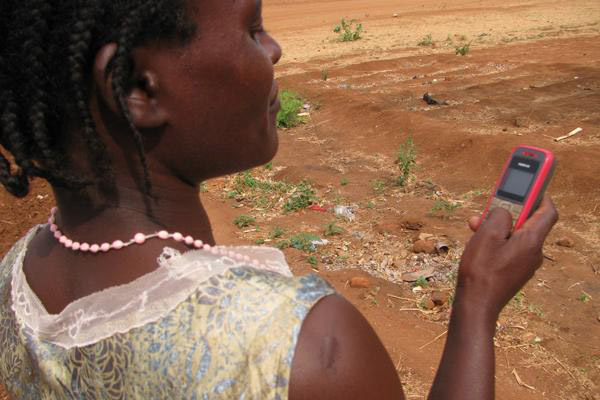
UN bodies present projects showing how ‘Big Data’ can save lives
The UN World Food Programme (WFP) and UN Global Pulse – an innovation initiative of the Secretary-General – have teamed up on research projects exploring the link between mobile phone usage and hunger and they are presenting their findings at the Netmob Conference for Scientific Analysis of Mobile Phone Data at the Massachusetts Institute of Technology in Boston, United States.
“This is a new frontier for humanitarian assistance,” said Arif Husain, WFP Chief Economist.
He added, “As agencies begin adopting these new techniques, information collection will become cheaper and faster, making relief programmes much more responsive to the needs of hungry poor worldwide.”
The joint projects focused on ways anonymous mobile phone data could be analysed to understand household hunger and vulnerability patterns, and doing so in real-time helps humanitarian agencies pinpoint areas of acute need with a level of speed and precision that have never been achieved before.
They uncovered a new method for estimating household expenditures on food based on mobile phone spending patterns in Africa, along with a technique for potentially identifying households for assistance during floods in Mexico and a method to quantify population mobility patterns in relation to the agricultural and livelihood cycles based on calling patterns in Senegal.
“New technologies are leading to an exponential increase in the volume and types of data available, creating unprecedented possibilities for improving humanitarian aid,” said Makena Walker, Deputy Director of Global Pulse, the UN body that explores how new, digital data sources and real-time analytics technologies can help policy-makers gain better understandings of changes in human well-being and emerging vulnerabilities.
In particular, “big data” generated by mobile and online communications offers major opportunities to complement more traditional data sources, such as face-to-face surveys and satellite imagery, used by humanitarian agencies.
The difference is that call data records offer the opportunity to do analysis in near real-time and at very low cost.
While the big data revolution offers tremendous opportunities, agencies are extremely mindful of the pitfalls that using such information sources implies.
“Protecting people’s privacy is of utmost concern as we develop these new approaches,” said Walker.
UN Global Pulse and WFP are appealing to telecommunications companies to join the effort in making this type of information available to the humanitarian community, where it would be used for the common good.
Photo: WFP/Gregory Barrow
Support Our Journalism
We cannot do without you.. your contribution supports unbiased journalism
IBNS is not driven by any ism- not wokeism, not racism, not skewed secularism, not hyper right-wing or left liberal ideals, nor by any hardline religious beliefs or hyper nationalism. We want to serve you good old objective news, as they are. We do not judge or preach. We let people decide for themselves. We only try to present factual and well-sourced news.
Support objective journalism for a small contribution.


