


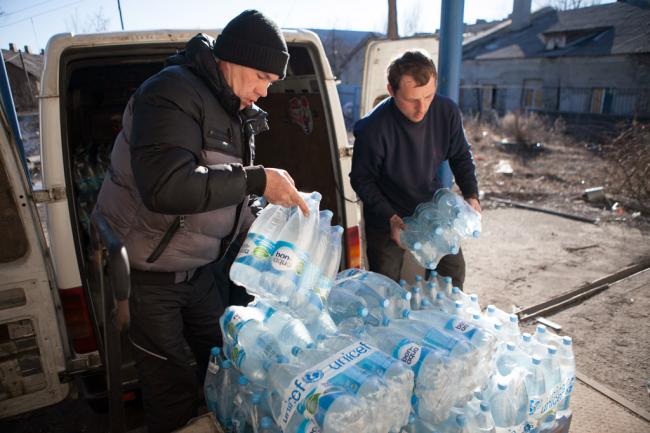
Ukraine: UNICEF appeals to restore damaged water facilities for 1.3 million people
Robert McCarthy, UNICEF’s Regional Chief of Emergency for Central and Eastern Europe and the Commonwealth of Independent States (CIS), who has just completed a mission to take stock of the situation in eastern Ukraine, namely in Donetsk and Luhansk, also said humanitarian actors needed to strengthen response to the impact of violence and displacement on children.
“In terms of water supply, up to 1.3 million adults and children faced a serious water crisis due to damaged or destroyed water lines and acute water shortages,” McCarthy told reporters at a press briefing in Geneva, Switzerland.
“More than 470,000 people, including 118,000 children, were also facing serious problems in accessing safe water in non-government areas of Luhansk region,” he said.
The UNICEF officials said many families had to rely on trucks or travel to neighbouring villages to get water from functioning wells.
McCarthy noted that Mariupol, which was under Government control, is no longer receiving water from the water channel damaged by shelling and that the city is now reliant on a water-storage reservoir that is rapidly depleting.
“The risk of waterborne disease is likely to increase as people are unable to store or transport water safely,” he warned.
He appealed for more humanitarian partners to assist in the emergency water and sanitation response despite the fact that UNICEF and its partners have helped more than 500,000 people in Donetsk and Luhansk regions to access safe water since January 2015.
Nearly 1.4 million people are displaced, including at least 174,000 children in Ukraine, where the humanitarian crisis affects more than 5 million people, including 1.7 million children, and movement across the Government/non-government-controlled areas remained difficult, according to UNICEF.
“As the winter season approaches, there is a need to improve contingency planning,” McCarthy said.
He appealed on behalf of UNICEF for $55.8 million to meet the urgent humanitarian needs of children and families in eastern Ukraine for 2015. To date, just $10.48 million, or 20 percent of what was needed, had been received.
Photo: UNICEF/Aleksey Filippov
Support Our Journalism
We cannot do without you.. your contribution supports unbiased journalism
IBNS is not driven by any ism- not wokeism, not racism, not skewed secularism, not hyper right-wing or left liberal ideals, nor by any hardline religious beliefs or hyper nationalism. We want to serve you good old objective news, as they are. We do not judge or preach. We let people decide for themselves. We only try to present factual and well-sourced news.
Support objective journalism for a small contribution.


