


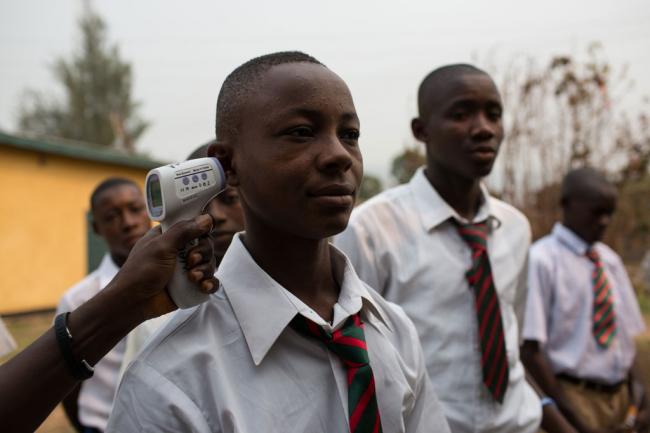
Stringent hygiene protocols keep classrooms in West Africa free of Ebola: UNICEF
“The massive effort that went into making schools as safe from Ebola transmission as possible appears to have paid off,” said Geoff Wiffin, UNICEF Representative in Sierra Leone.
He added, “Children learned in school how to protect themselves and others from Ebola, and they passed on those messages to their parents and their communities. This played an important role in the battle against the epidemic.”
Across the three countries, there have been no reported cases of a student or teacher being infected at a school since strict hygiene protocols were introduced when classes resumed at the beginning of the year after a months-long delay caused by the virus, apress releasepoints out.
In Liberia, two schools were decontaminated as a precaution following the death of a student in June and the infection of another in July.
Developed by UNICEF and its partners, the protocols include taking the temperature of children and staff at the school gate and installing handwashing stations.
They also involved the distribution of millions of bars of soap and chlorine, and the training of tens of thousands of teachers and administrators in the protocols and in providing psychosocial support.
Some five million children lost months of education as schools remained closed from July 2014 until the first months of 2015 in the three worst-affected countries, which already had poor education numbers: before Ebola, 58 per cent of children attended primary school in Guinea, 34 per cent in Liberia and 74 per cent in Sierra Leone.
UNICEF is working to ensure the prevention protocols remain in place after the holidays, while supporting efforts to make education systems more resilient, by addressing issues such as low enrolment, shortages of quality teachers, and access to safe water.
Only 33 per cent of primary schools have access to water in Guinea, 45 per cent in Liberia, and some 40 per cent in Sierra Leone. Maintaining safe hygiene practices and standards will also be important in protecting children from other illnesses.
Due to the success of the measures, Guinea-Bissau has begun implementing similar protocols as a precaution, after people who had been in contact with an infected person in neighbouring Guinea were believed to have crossed the border and could not be tracked down.
Photo: © UNICEF/NYHQ2015-0768/Tanya Bindra
Support Our Journalism
We cannot do without you.. your contribution supports unbiased journalism
IBNS is not driven by any ism- not wokeism, not racism, not skewed secularism, not hyper right-wing or left liberal ideals, nor by any hardline religious beliefs or hyper nationalism. We want to serve you good old objective news, as they are. We do not judge or preach. We let people decide for themselves. We only try to present factual and well-sourced news.
Support objective journalism for a small contribution.


