


 Somali Livelihoods
Poor seasonal rains threatening ‘foundations’ of tens of thousands of Somali livelihoods
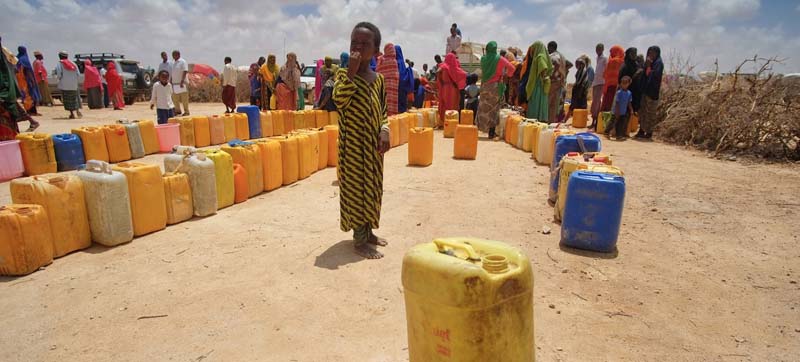
New York: Poor rain forecast for the next few months threatens to exacerbate the plight of tens of thousands of Somalis displaced from their homes and villages due to “extreme” water shortages since last November, the UN humanitarian office said on Friday.
Jens Laerke, spokesperson for the UN Office for Coordination of Humanitarian Affairs (OCHA), said that pre-drought conditions have already been reported in parts of Somaliland, Puntland, Hirshabelle, Galmudug and Jubaland regions of the Horn of Africa country after the poor seasonal rains late last year.
“The loss of rain-fed pasture is threatening the survival of livestock which is the foundation of many Somalis’ livelihoods. Displaced people have told [us] that they are moving in search of water and pasture for their animals”, he added.
An estimated 2.7 million people in Somalia, including about 840,000 children aged under five, are at risk of “crisis level” of food insecurity “or worse”, between April and June – the main rainy season in the country, Mr. Laerke added.
“That is an increase of more than 65 per cent compared to current levels. Water shortages will also increase the risk of disease outbreaks.”
Response efforts
He went on to note that humanitarian organizations are delivering water to some 300,000 people in affected areas, and $13 million has been released from the Somalia Humanitarian Fund to step up response efforts.
A rapid response allocation of $7 million from the Central Emergency Response Fund (CERF) is also on its way, and up to $20 million will be released to fund anticipatory action in Somalia, the OCHA spokesperson added.
A complex, multi-layered crisis
Somalia has been plagued by a complex, multi-layered humanitarian crisis for decades, further complicated by conflict, climate shocks, disease outbreaks and weak social protection mechanisms. Since last year, Desert Locust infestations and the COVID-19 pandemic have added to the challenges.
In 2021, an estimated 5.9 million people across Somalia – including 15 per cent women and 66 per cent children – are expected to require humanitarian support.
UN and humanitarian partners aim to reach about 4 million vulnerable people with life-saving assistance through the year, for which they require about $1.09 billion. However, only 2.5 percent of that amount has been secured so far.
The appeal responds to humanitarian programmes across eight emergency clusters, spanning education, food security and livelihoods, health, logistics, non-food items (NFIs) and emergency shelter, nutrition, protection, and water, sanitation and hygiene (WASH).
Support Our Journalism
We cannot do without you.. your contribution supports unbiased journalism
IBNS is not driven by any ism- not wokeism, not racism, not skewed secularism, not hyper right-wing or left liberal ideals, nor by any hardline religious beliefs or hyper nationalism. We want to serve you good old objective news, as they are. We do not judge or preach. We let people decide for themselves. We only try to present factual and well-sourced news.
Support objective journalism for a small contribution.


