


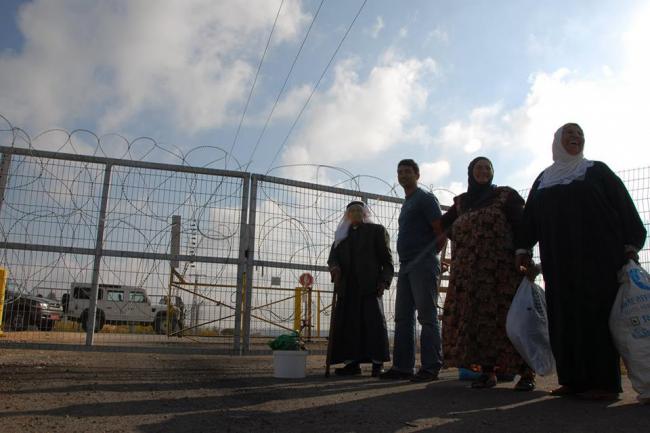
Palestinian life in West Bank constrained by Israeli policies – UN expert
The crisis in war-torn Gaza is deepening. In the West Bank, including East Jerusalem, there are daily infringements of Palestinian rights as land is increasingly lost to illegal settlements,” warned the United Nations Special Rapporteur on the situation of human rights in the Palestinian territories occupied since 1967.
Reporting at the Human Rights Council, Makarim Wibisono said “that occupation policies constrain Palestinian life and push Palestinians to leave their land and homes, especially in area C of the West Bank, and East Jerusalem,” said the expert after his second mission to the region.
From 9 to 12 June, Wibisono visited Amman, Jordan, where he met with civil society and Palestinian local community representatives, UN agencies, and Palestinian government officials. He was unable to access the Occupied Palestinian Territory (OPT), as the Israeli Government has not granted him access and has not formally responded to his requests.
“Accountability is critical for dealing with past violations as well as preventing future ones,” he explained. “This includes accountability for violations in the context of successive Israeli military operations, including the 2014 hostilities in Gaza. It is the only way to move forward.”
Nine months after the ceasefire, some 12,600 Gaza homes totally destroyed during the 2014 hostilities with Israel, “not a single one has been rebuilt”, stated the UN independent expert, claiming that multiple factors affect the slow reconstruction in Gaza, including unfulfilled donor pledges.
Wibisono noted that the blockade around the strip, now in its eighth year, imposes severe restrictions on Palestinian movement, imports and exports and has left Gaza dependent on international aid and with soaring unemployment.
“The bottom line remains that, if Gaza is to recover from the damage wrought by multiple rounds of hostility and a shattered economy, the blockade must be lifted. The people deserve help and realisation of their human rights, not collective punishment,” he advocated.
The Special Rapporteur was also briefed on the lack of access to health care in Gaza, where more than 11,000 Palestinians were left injured after last summer’s escalation of hostilities. “Health services too are affected by the blockade. There are prolonged and chronic shortages of drugs and medical supplies,” he said.
In addition, the expert was briefed on how the extensive damage caused to civilian infrastructure has worsened the provision of essential utility services. “One man described how ‘Gazans wake up every day to wash with salt-water and sleep at the end of the day without electricity’ – People are deprived of the means to help themselves and they cannot leave – this is a very dangerous situation,” he warned.
In the West Bank, including East Jerusalem, the independent expert noted the “interplay” between Israeli control of natural resources, such as land and water, and advancement of Israeli settlements.
“The impact of untreated sewage and waste from settlements on Palestinian crops and the environment is also concerning,” Wibisono added, stressing the situation of families that live under the threat of settler violence, home demolitions and forcible transfer.
“Occupation policies and practices go beyond control of land – they impact every aspect of life and wear heavily on the social fabric of communities,” he said.
Concerned by movement restrictions between Gaza and the West Bank, the West Bank and East Jerusalem, and within the West Bank, including by the separation wall, the Special Rapporteur highlighted that Palestinians family and social life is “dictated” by the granting or refusal by the Israeli authorities of the right permit.
Finally, he expressed concern over Palestinian deaths and injuries resulting from excessive use of force by Israeli security forces, as well as detention.
Photo: UNRWA/Isabel de la Cruz
Support Our Journalism
We cannot do without you.. your contribution supports unbiased journalism
IBNS is not driven by any ism- not wokeism, not racism, not skewed secularism, not hyper right-wing or left liberal ideals, nor by any hardline religious beliefs or hyper nationalism. We want to serve you good old objective news, as they are. We do not judge or preach. We let people decide for themselves. We only try to present factual and well-sourced news.
Support objective journalism for a small contribution.


