


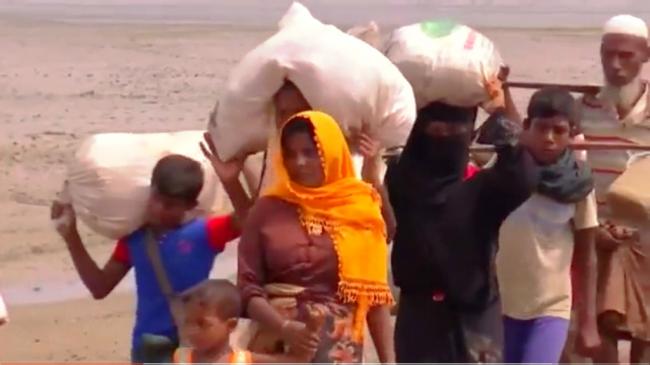
New Rohingya arrivals in Bangladesh at risk from poor diets
Cox's Bazar, Jan 5 (IBNS): A new study shows that although more than 90 percent of Rohingya refugees in Cox’s Bazar have received emergency food assistance, a major concern is limited access to a well-diversified and balanced diet.
The Rohingya Emergency Vulnerability Assessment (REVA) was carried out by the United Nations World Food Programme (WFP) and Food Security Sector partners in November and December 2017.
More than 2,000 families were interviewed to understand the priority needs of refugees and host communities.
Households were asked about their diet, expenditure on food and other items, and what measures they resorted to in order to feed family members, amongst other things.
With more than 656,000 people fleeing into Bangladesh from Myanmar since 25 August 2017, on top of a previous refugee community of around 300,000 people, the food security situation in Cox’s Bazar is extremely precarious.
WFP is providing food and food vouchers to more than 700,000 refugees.
Country Director Christa Rader explained: “WFP will scale up its e-voucher programmes in 2018 to reach new arrivals in Cox’s Bazar. Food vouchers for refugees make sense on all levels: it leads to more nutritious diets, it empowers women, and in the long run, it costs less than distributing actual food.”
The study highlights that people who receive e-vouchers have a better-quality diet than those who do not, and in response WFP will scale up this programme in 2018. Currently, some 90,000 people are enrolled in WFP’s e-voucher programmes, under which they receive a monthly amount on a pre-paid debit card which can be used in allocated shops to buy 19 different foods, including rice, lentils, fresh vegetables, chillies, eggs and dry fish.
By contrast, WFP’s food distributions to the new arrivals is rice, vegetable oil and lentils – an emergency ration designed to provide basic calories, but lacking in dietary diversity. Women are the receivers of the e-voucher card for each family, they can then take decisions on what to buy and how to allocate the assistance provided among family members. In light of the very high levels of acute malnutrition according to surveys conducted in October and November, WFP is also providing nutrition support to children under five years of age and pregnant and breast-feeding women.
The study also recommends the scaling up of livelihood support programmes within host communities prioritizing especially women who have no income. Similarly, the study advises that refugees in the camps should be given the opportunity to earn cash in order to reduce their economic vulnerability. Also, the study advocates for the scaling-up of services and the distribution of non-food items to meet other basic needs, including improving the access firewood and drinking water meeting minimum quality standards.
Support Our Journalism
We cannot do without you.. your contribution supports unbiased journalism
IBNS is not driven by any ism- not wokeism, not racism, not skewed secularism, not hyper right-wing or left liberal ideals, nor by any hardline religious beliefs or hyper nationalism. We want to serve you good old objective news, as they are. We do not judge or preach. We let people decide for themselves. We only try to present factual and well-sourced news.
Support objective journalism for a small contribution.


