


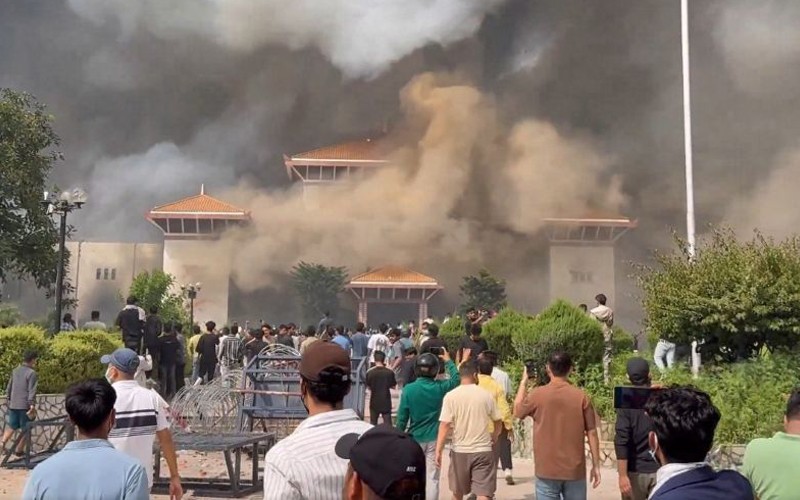
Nepal's parliament set on fire after PM KP Sharma Oli resigns over anti-corruption protests
Nepali demonstrators on Tuesday set the parliament ablaze as Prime Minister KP Sharma Oli resigned, bowing to unprecedented protests led by the country’s Gen Z.
The protests intensified on Tuesday with demonstrators setting fire to the private residences of Prime Minister KP Sharma Oli and President Ram Chandra Poudel, as public anger over corruption, governance failures, and a controversial social media ban spiraled into widespread unrest.
According to The Kathmandu Post, protesters also torched the ruling Nepali Congress party’s central office in Sanepa and vandalised the houses of former prime ministers Pushpa Kamal Dahal ‘Prachanda’ and Sher Bahadur Deuba, along with Energy Minister Deepak Khadka’s residence.
According to The Kathmandu Post, protesters also torched the ruling Nepali Congress party’s central office in Sanepa and vandalised the houses of former prime ministers Pushpa Kamal Dahal ‘Prachanda’ and Sher Bahadur Deuba, along with Energy Minister Deepak Khadka’s residence.
Prime Minister KP Oli's house is on fire.Genz protesters have been taking to the streets against corruption since September 8. #GenZProtest #Nepalprotest pic.twitter.com/uOcPOZIl3q
— Pratima Makhim (@pmakhim) September 9, 2025
Prime Minister KP Sharma Oli's private residence in Bhaktapur set ablaze by protesters. Oli's endgame looks eerily similar to Rajapaksa #NepalProtests pic.twitter.com/UCXdTx08vP
— Atishay Jain (@AtishayyJain96) September 9, 2025
The week-long demonstrations erupted after the Oli government imposed a sweeping ban on 26 social media platforms, including Facebook, Instagram, YouTube, and X, sparking outrage among Gen Z, who considered the move a curb on free expression.
The unrest turned deadly when police opened fire on demonstrators. At least 19 people were killed nationwide, with 18 deaths in Kathmandu alone, and hundreds more were injured.
Media reports, quoting witnesses, reported that several of the victims were students, dressed in their school and college uniforms.
A generation at a crossroads
Nepal’s Gen Z, those born after 1997, make up nearly 30% of the population. Having grown up in a republic established after the 2006 abolition of the monarchy, they are digitally native, politically restless, and skeptical of the old guard.
Scenes from Kathmandu, where Gen Z protesters rallied against corruption and the Nepal government’s move to ban several social media apps. #NepalGenZProtest #Nepalprotest pic.twitter.com/rBORWPq4Lo
— India Blooms (@indiablooms) September 9, 2025
Their protests are not just about social media censorship but reflect an uprising against unemployment, brain drain, and poor governance.
According to the Department of Foreign Employment, hundreds of thousands of young Nepalis leave the country each year to seek employment abroad.
What comes next?
Oli’s resignation has left a vacuum at the center of Nepal’s fragile politics. The ruling coalition is struggling to find a replacement, but with no single party commanding overwhelming support, the path forward is uncertain.
The opposition is already maneuvering, and concerns are growing about a protracted power struggle.
Meanwhile, protesters vow to stay on the streets until meaningful changes are promised.
Support Our Journalism
We cannot do without you.. your contribution supports unbiased journalism
IBNS is not driven by any ism- not wokeism, not racism, not skewed secularism, not hyper right-wing or left liberal ideals, nor by any hardline religious beliefs or hyper nationalism. We want to serve you good old objective news, as they are. We do not judge or preach. We let people decide for themselves. We only try to present factual and well-sourced news.
Support objective journalism for a small contribution.


