


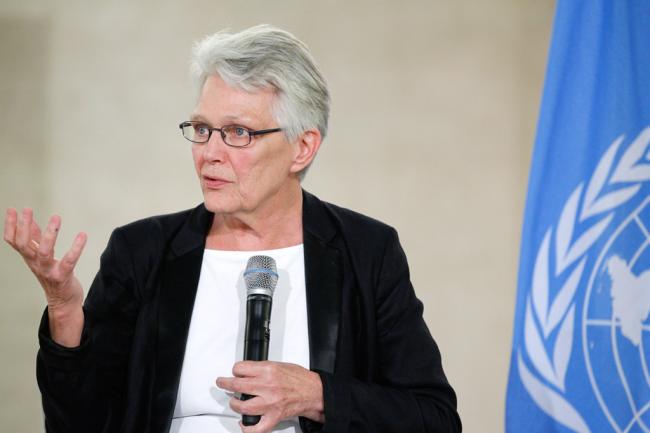
Hurricane Katrina's 'true legacy' was to spur disaster risk management: UN official
“Hurricane Katrina exposed weaknesses in disaster risk management which are common to many hazard prone locations around the world,” said the head of the UN Office for Disaster Risk Reduction (UNISDR), Margareta Wahlström.
“We can learn a lot from New Orleans if we are to achieve substantial reductions in disaster losses as called for in the Sendai Framework for Disaster Risk Reduction which was adopted by governments earlier this year,” she said.
The Sendai Framework, named after the Japanese city in which it was adopted by Governments earlier this year, is a 15-year, voluntary, non-binding agreement – and the first major agreement of the new UN sustainable development agenda – with seven targets and four priorities for action.
Wahlström said, “New Orleans has transformed itself into a role model for disaster resilience.”
“It continues to invest heavily in improving flood defences and major efforts have been made to engage citizens in the renewal of the city,” she continued.
She added, “There is better mapping of the city’s hazards and there is greater awareness among the population about the importance of disaster risk management in ensuring the sustainable social and economic development of the city.”
She also said “many lessons learned from New Orleans have been incorporated into the Sendai Framework including the need to engage the elderly and other potentially vulnerable groups in disaster planning and to make adequate provision for their safety when a disaster strikes.”
“Hurricane Katrina has taught us that disaster risk reduction must be people-centred and engage all sectors of society,” she said.
Wahlström’s Office is dedicated to disaster risk reduction and supports implementation of the Sendai Framework which seeks “the substantial reduction of disaster risk and losses, in lives, livelihoods and health and in the economic, physical, social, cultural and environmental assets of persons, businesses, communities and countries.”
Photo: UN Photo/Pierre Albouy
Support Our Journalism
We cannot do without you.. your contribution supports unbiased journalism
IBNS is not driven by any ism- not wokeism, not racism, not skewed secularism, not hyper right-wing or left liberal ideals, nor by any hardline religious beliefs or hyper nationalism. We want to serve you good old objective news, as they are. We do not judge or preach. We let people decide for themselves. We only try to present factual and well-sourced news.
Support objective journalism for a small contribution.


