


 Afghanistan Children
Half of Afghanistan’s under-5s expected to suffer acute malnutrition
New York: An estimated 3.2 million Afghan children under five, are expected to suffer from acute malnutrition by the end of the year, UN agencies warned on Tuesday, adding that without immediate treatment, at least a million are at risk of dying.
Acute food insecurity is affecting 14 million people in Afghanistan who are without reliable access to water, food and basic health and nutrition services, following years of conflict and the economic crisis, which has been exacerbated following the Taliban takeover in August.
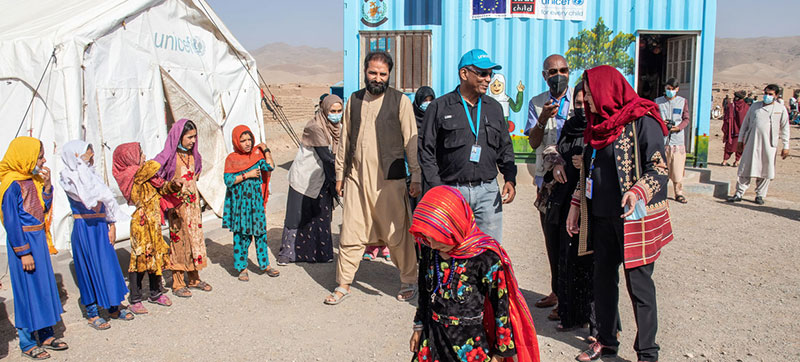
The alarm was sounded following a two-day visit to the city of Herat by Hervé Ludovic De Lys, UN Children’s Fund (UNICEF) Representative in Afghanistan and Mary-Ellen McGroarty, World Food Programme’s (WFP) Afghanistan Representative and Country Director.
Mothers struggling to breastfeed
Mr. De Lys and Ms. McGroarty spoke with a mother who could no longer breastfeed her daughter. The 18-month-old is being treated for severe acute malnutrition at the Herat Regional hospital. “We have no food at home. We are selling everything to buy food, yet I barely eat anything. I am weak and I don’t have any milk for my child,” Jahan Bibi told them.
“As more families struggle to put food on the table, the nutritional health of mothers and their children is getting worse by the day,” said Mr. De Lys.
“Children are getting sicker and their families are less and less able to get them the treatment they need. Rapidly spreading outbreaks of measles and acute watery diarrhoea will only exacerbate the situation.”
Families face ‘desperate choices’
According to surveys by WFP, 95 per cent of households in Afghanistan are not consuming enough food, adults are eating less and skipping meals so their children can eat more.
“We have huge concerns about the desperate choices families are being forced to take,” said Ms. McGroarty. “Unless we intervene now, malnutrition will only become more severe. The international community must release the funds they pledged weeks ago, or the impact could be irreversible.”
Drought, jobs
Ms. McGroarty and Mr. De Lys visited a food distribution centre in Herat city where they met families struggling to make ends meet amidst drought and lack of jobs.
They also visited a settlement for internally displaced families where mobile health and nutrition teams have been providing life-saving services to women and children, supported by UNICEF and WFP.
The two UN agencies are adding 100 more mobile health and nutrition teams. Already 168 mobile teams have been providing a lifeline for children and mothers in hard-to-reach areas.
Life-saving assistance
Since the beginning of 2021, WFP has provided life-saving food and nutrition assistance to 8.7 million people, including treatment and prevention of malnutrition for nearly 400,000 pregnant and breastfeeding women and 790,000 children under five.
Close to four million people were reached in September alone. Additionally, this year, more than 210,000 children with severe acute malnutrition were provided with lifesaving treatment through UNICEF-supported services. Ready-to-use therapeutic food for more than 42,000 children and therapeutic milk for 5,200 children, was also delivered to UNICEF partners, in the past eight weeks.
Support Our Journalism
We cannot do without you.. your contribution supports unbiased journalism
IBNS is not driven by any ism- not wokeism, not racism, not skewed secularism, not hyper right-wing or left liberal ideals, nor by any hardline religious beliefs or hyper nationalism. We want to serve you good old objective news, as they are. We do not judge or preach. We let people decide for themselves. We only try to present factual and well-sourced news.
Support objective journalism for a small contribution.


