


 Mamdani
From subway to scripture: How Zohran Mamdani rewrote New York City’s Mayoral oath on Quran
New York/IBNS: New York City entered 2026 with a mayoral moment unlike any in its long political history.
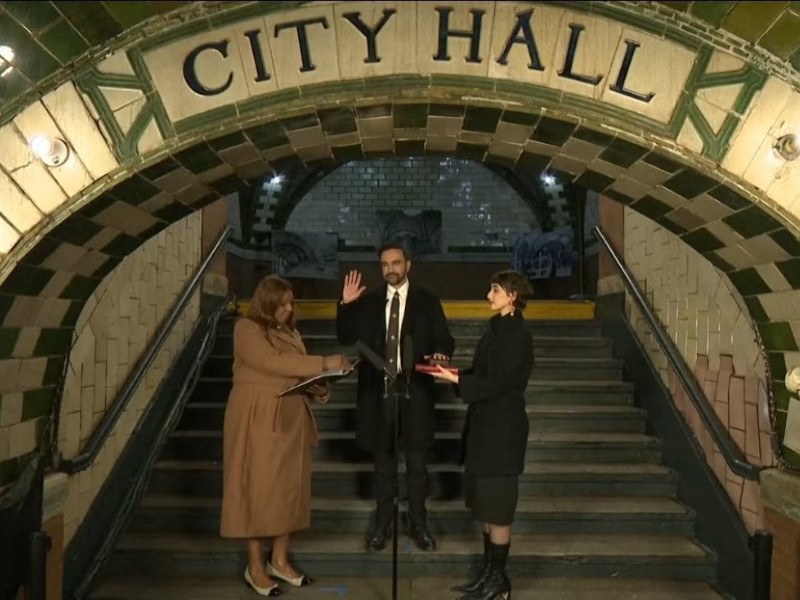
Zohran Mamdani, the city’s newly elected mayor, broke with centuries of civic tradition by taking his oath of office on the Quran and doing so inside a long-abandoned subway station beneath City Hall.
The unprecedented ceremony immediately set Mamdani apart, signalling a leadership style rooted in symbolism, inclusion and a reimagining of how power connects with everyday New Yorkers.
At just 34, Mamdani is not only the youngest mayor New York City has seen in a century but also its first Muslim mayor and first mayor of South Asian descent.
His swearing-in ceremony reflected each of those milestones, blending faith, history and infrastructure into a statement about the city’s evolving identity.
Midnight beneath City Hall: An unconventional oath
As the clock struck midnight on January 1, Mamdani officially assumed office in a private ceremony held inside the decommissioned Old City Hall subway station in Manhattan.
Closed to the public since 1945, the station is one of the original stops from New York’s first underground subway line, opened in 1904.
Rarely accessible and steeped in history, it provided a dramatic and symbolic setting for the start of Mamdani’s term.
🚨Zohran Mamdani has been sworn-in as the 112th Mayor of New York City. pic.twitter.com/Z5WY5WObwp
— Pop Crave (@PopCrave) January 1, 2026
The oath was administered by New York State Attorney General Letitia James, a close political ally and early supporter of Mamdani’s mayoral bid.
Attendance was limited to family members and a small group of invited guests, reinforcing the reflective and intimate tone of the moment.
Mamdani’s office said the choice of location was deliberate, describing the station as a monument to a time when New York invested boldly in public infrastructure to improve working people’s lives.
For the new mayor, beginning his tenure underground was meant to signal a renewed commitment to that ambition.
The first Mayor to take oath on the Quran
What made the ceremony truly historic was Mamdani’s decision to place his hand on the Quran while taking the oath of office.
No previous mayor in New York City’s history has done so.
The act marked a powerful first for religious representation in the city’s highest municipal office and underscored the changing face of political leadership in America’s largest city.
Mamdani is expected to use multiple Qurans across his private and public swearing-in ceremonies.
For the midnight oath, he reportedly used his grandfather’s Quran as well as one associated with Arturo Schomburg, the renowned Black writer and historian, lent by the New York Public Library.
The selection reflected both personal heritage and broader historical resonance.
By choosing the Quran, Mamdani joined a small but growing group of American officials who have used texts other than the Bible for their oaths, reinforcing the constitutional principle that public office is not tied to a single faith.
A public ceremony with progressive allies
Later on January 1, Mamdani took the oath again during a public ceremony on the steps of City Hall.
This event, far more traditional in setting but not in tone, was led by Senator Bernie Sanders, one of Mamdani’s most influential political inspirations.
Opening remarks were delivered by Representative Alexandria Ocasio-Cortez, highlighting the progressive coalition that powered Mamdani’s rise.
The public ceremony was followed by a Broadway block party featuring music, performances and interfaith elements, transforming the inauguration into a citywide celebration.
Mamdani’s transition team said the goal was to make the moment accessible, communal and reflective of New York’s diversity.
Blending faith, infrastructure and identity
Mamdani’s two-stage inauguration followed a long-standing New York tradition of midnight oaths followed by public ceremonies later in the day.
Former mayors Bill de Blasio and Eric Adams both observed similar practices, though in far more conventional locations.
Mamdani’s decision to move the moment underground — and to anchor it in his faith — marked a sharp departure.
In a statement explaining the choice, Mamdani said the Old City Hall station symbolised a city that once dared to build beautifully and ambitiously for the public good.
That same spirit, he suggested, would guide his administration above ground at City Hall.
Support Our Journalism
We cannot do without you.. your contribution supports unbiased journalism
IBNS is not driven by any ism- not wokeism, not racism, not skewed secularism, not hyper right-wing or left liberal ideals, nor by any hardline religious beliefs or hyper nationalism. We want to serve you good old objective news, as they are. We do not judge or preach. We let people decide for themselves. We only try to present factual and well-sourced news.
Support objective journalism for a small contribution.


