


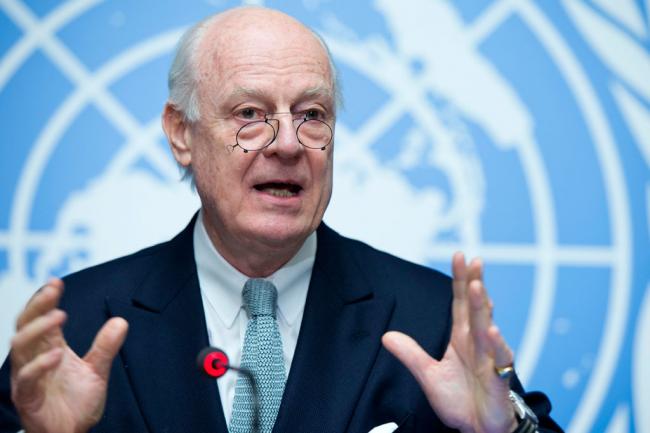
Delayed intra-Syrian talks, brokered by UN, to begin on Friday in 'uphill' bid for ceasefire
But in announcing the new date, for which invitations will be sent out on Tuesday, Special UN Envoy for Syria Staffan de Mistura said he is under no illusions about the difficulties in ending a war that has killed over 250,000 people, sent over 4 million fleeing the country, displaced 6.5 million internally, and put 13.5 million people inside the country in urgent need of humanitarian aid.
“In terms of vision, things may get faster, things may get slower, I can tell you in advance, don’t be surprised,” he told a news conference in Geneva. “There will be a lot of posturing, we know that, a lot of walk-outs and walk-ins because a bomb has fallen or because someone has done an attack, and you will see that happening,” he said.
“We should not be impressed, neither depressed, but it’s likely to happen. The important thing is that we keep the momentum,” he stressed.
The meetings will start with proximity talks and are expected to last for six months, with Government and opposition delegations sitting in separate rooms and UN officials shuttling between them. Any ceasefire would not cover ISIL of the Al-Nusra Front.
The talks stem from an agreement reached in Vienna in November by the International Syria Support Group (ISSG), comprising the Arab League, the European Union, the United Nations, and 17 countries including the United States and Russia, as part of an effort to end the five-year-long war with an agreement on new governance, a new constitution and new elections.
The first phase could last two to three weeks before preparations are made for further phases and there will be no opening ceremony, de Mistura said, stressing that there will be a substantial presence of civil society and women, who represent 51 per cent of the total population.
“There are political risks,” he added. “But those political risks, and tensions and positioning and prepositioning should be also taking into account that our line is, and the Security Council has been clear, no pre-conditions at least to start it off and while the talks start.
“The rest is open… is going to be uphill. They are not in an agreement yet, but we are all feeling… that the time has come to at least try hard to produce an outcome,” he noted.
He said he expected there to be “a lot of shuttling because there is not only different delegations but there are also civil society, women and others who deserve to be heard,” with UN facilitators attending a lot of simultaneous meetings.
Meanwhile, UN Special Envoy for Global Education Gordon Brown has warned that 2.5 million children could be displaced as refugees from Syria by the end of 2016, adding that the only way to ensure they remain in the region is to provide stability through a new plan for double-shift education.
Under that system, local children would be schooled in the mornings and early afternoons, and refugee boys and girls would use the same classrooms in late afternoon and early evening. The plan will cost an initial $750 million, but $500 million has already been raised through offers of grants or loans from countries and businesses.
UN Photo/Jean-Marc Ferré
Support Our Journalism
We cannot do without you.. your contribution supports unbiased journalism
IBNS is not driven by any ism- not wokeism, not racism, not skewed secularism, not hyper right-wing or left liberal ideals, nor by any hardline religious beliefs or hyper nationalism. We want to serve you good old objective news, as they are. We do not judge or preach. We let people decide for themselves. We only try to present factual and well-sourced news.
Support objective journalism for a small contribution.


