


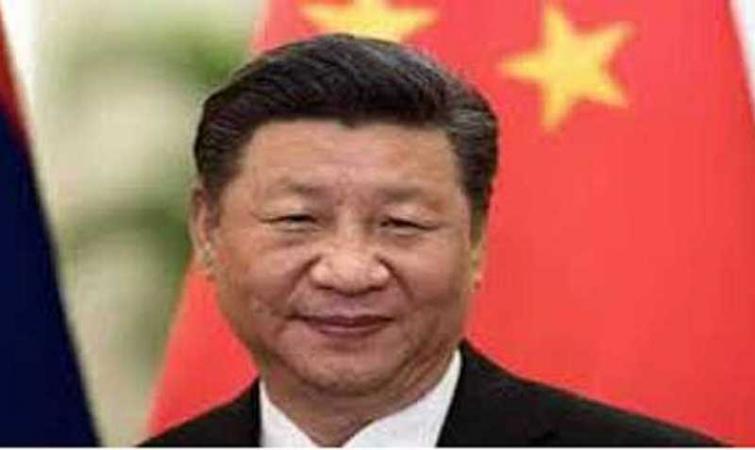
China determined to end poverty by 2020
Beijing, Apr 20 (UNI) Chinese President Xi Jinping is determined to end all of the poverty in China by 2020.
In the small village of Gaibao, locals are filming short videos of their unspoiled and idyllic countryside on the Kwai streaming app.
One clip shows four young women laughing as they grab fat fish out of the rice fields with their hands. In another they don traditional outfits and stand next to an ox plowing a paddy field. "Do you all have a farm such as this?" the caption asks.
Their short videos are a small part of a massive nationwide attempt to lift all of China's 1.4 billion people out of poverty by 2020 -- a goal which President Xi Jinping set in a speech in 2015.
The Chinese government defines poverty as earning less than $416 (2,800 yuan) a year or around $1.10 a day -- a lower benchmark than the World Bank poverty line of $1.90 a day, or just under $700 a year.
Beijing has dispatched about 775,000 party officials to drive the anti-poverty campaign. Many are going door-to-door to work out what the government can do to help, CNN reported. Those who fail in their missions to alleviate poverty could face career oblivion, according to state media.
The idea to stream videos of the village came from Gaibao's chief poverty alleviation official, Wu Yusheng, and has helped the town, in the province of Guizhou, sell its organic produce online.
Residents also receive virtual gifts from fans via the app, which they can exchange for cash.
Wu, who arrived in the village in 2018, said he had already achieved his goal -- but it is unclear whether Xi will do the same.
At worst, some experts fear the ruling Communist Party might just announce poverty has been eradicated, regardless of the reality, to avoid embarrassing Xi.
"Local leaders are taking it extremely seriously, almost in a panicky way. Part of the problem is that they don't know really what to do, so they're kind of grasping at different solutions," said John Donaldson, a poverty expert and associate professor at Singapore Management University. "They're throwing everything at it."
The dream of eradicating widespread poverty in China didn't begin with Xi. It dates back to the Communist Party's rise to power in 1949. "The reason for the existence of the Chinese Communist Party in the beginning is because of injustice and poverty among farmers," Donaldson said.
Chairman Mao Zedong's economic experiments, however, actually set the country back, according to Steve Tsang, director of the China Institute at the University of London.
"In 1949, Shanghai was still a richer city than Hong Kong. In 1949, any coastal province was richer and more developed than Taiwan. In 1979, Hong Kong and Taiwan were way, way ahead," Tsang said.
Mao's disastrous Great Leap Forward, beginning in 1958, was ostensibly an attempt to transform a mainly agrarian society through industrialization and collectivization. Instead, it helped create a famine that cost tens of millions of lives and aggravated poverty across the country.
Things began to change after Mao's death. In 1978, then-paramount leader Deng Xiaoping began liberalizing China's economy and one of his first reforms was to let struggling farmers sell excess produce to make a profit.
Support Our Journalism
We cannot do without you.. your contribution supports unbiased journalism
IBNS is not driven by any ism- not wokeism, not racism, not skewed secularism, not hyper right-wing or left liberal ideals, nor by any hardline religious beliefs or hyper nationalism. We want to serve you good old objective news, as they are. We do not judge or preach. We let people decide for themselves. We only try to present factual and well-sourced news.
Support objective journalism for a small contribution.


