


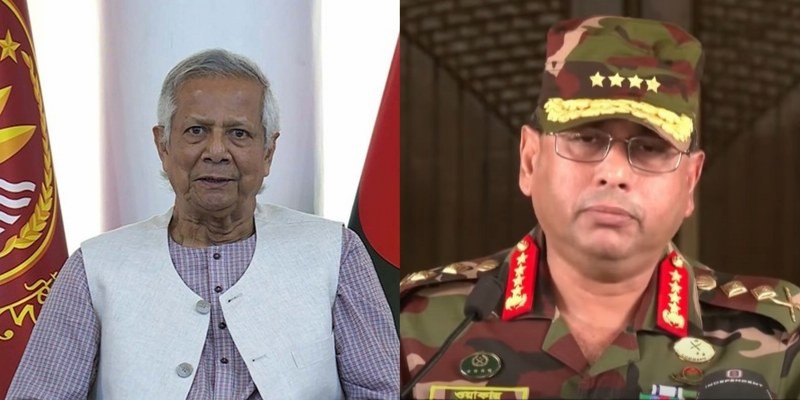
‘Bloody corridor’: Bangladesh Army chief’s rebuke forces Yunus govt to retreat on UN-backed ‘Rakhine corridor’
Dhaka: Muhammad Yunus-led Bangladesh’s interim government has reversed its decision to support a UN-backed humanitarian corridor into Myanmar’s Rakhine State after a sharp rebuke from Army Chief General Waker-Uz-Zaman, who termed it a “bloody corridor”.
The general’s intervention came after Foreign Adviser Touhid Hossain unilaterally announced Bangladesh’s support for the proposal, triggering concerns over national sovereignty and foreign influence, according to an India Today report.
Sources suggest Yunus’ camp had agreed to the corridor under US pressure, in a bid to retain power without holding elections.
However, General Zaman publicly warned that the army would not tolerate any move undermining Bangladesh’s sovereignty.
“The Bangladesh Army will never be involved in any activity that is harmful to sovereignty. Nor will anyone be allowed to do so,” he said.
Zaman also advised Yunus to consult all political stakeholders on national security issues, including the controversial corridor plan, and called for early elections and non-interference in military matters.
The proposed route, originating in Chattogram, was framed as a channel for delivering aid to civilians caught in Myanmar’s escalating civil war.
But opposition parties like Khaleda Zia’s BNP and several Left groups denounced it as illegal and politically motivated.
Critics allege the project was part of a US plan to counter Chinese influence in the region.
An opinion piece in the Dhaka Tribune warned that the corridor could enable foreign intelligence and military access under the guise of aid delivery, posing security threats to both Bangladesh and Myanmar.
Following the military’s intervention, National Security Adviser Khalilur Rahman — a key Yunus appointee — clarified that no formal talks had been held with the UN on the corridor and none were planned.
He said the UN merely inquired whether Bangladesh could assist in transporting aid to the Myanmar border, which the government said it would “consider”.
Tarique Rahman of the BNP called the interim government’s earlier endorsement of the corridor undemocratic and opaque, taken without public consultation or parliamentary approval.
He insisted such decisions should be made only by a legitimately elected government.
Former diplomat Munshi Faiz Ahmad also raised alarms about the corridor serving as a strategic asset for US interests at the expense of Bangladesh’s relations with China.
Ahmad cautioned: “Without absolute control over such a corridor, we should categorically reject the idea… or risk stepping into a trap we cannot escape.”
The Yunus government’s retreat highlights its fragile political footing and underlines the army’s growing assertiveness as the de facto guarantor of national stability.
Support Our Journalism
We cannot do without you.. your contribution supports unbiased journalism
IBNS is not driven by any ism- not wokeism, not racism, not skewed secularism, not hyper right-wing or left liberal ideals, nor by any hardline religious beliefs or hyper nationalism. We want to serve you good old objective news, as they are. We do not judge or preach. We let people decide for themselves. We only try to present factual and well-sourced news.
Support objective journalism for a small contribution.


