


 Venezuela
Blinded and bypassed: How US electronic warfare and stealth jets crippled Russian and Chinese air defences in Venezuela
The United States’ surprise military operation on January 3, which led to the capture of Venezuelan President Nicolás Maduro and his wife, stunned the international community.
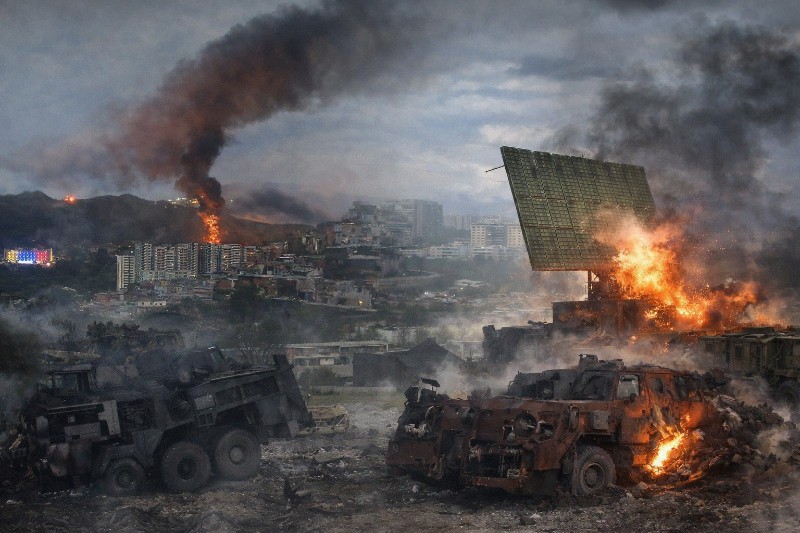
Beyond its political ramifications, the operation delivered a devastating assessment of Venezuela’s air defence network, built over decades using Russian and Chinese military technology.
Despite billions of dollars invested in advanced radars, surface-to-air missile systems and fighter aircraft, Venezuelan forces failed to detect, track or intercept incoming US aircraft.
The episode has since raised serious questions about the real-world effectiveness of Russian and Chinese air defence systems when confronted by modern American air power.
Venezuela’s reliance on Russian and Chinese military hardware
Venezuela’s military modernisation began under former president Hugo Chávez and continued under Maduro, driven by oil revenues and an informal US arms embargo.
Over the years, Caracas became one of Moscow’s most important defence clients in the Western Hemisphere while also expanding procurement from China.
By 2025, Venezuela fielded Russian-made S-300VM long-range missile systems, Buk-M2E medium-range missiles, Igla-S short-range air defences and Soviet-era Pechora systems.
Complementing these were Chinese-made radar arrays, including the JY-27A counter-stealth radar and JYL-1 long-range surveillance systems, along with FK-3 medium-range missile batteries deployed to protect key infrastructure.
Officials repeatedly claimed these systems formed a layered, integrated air defence network capable of countering stealth aircraft and deterring foreign intervention.
The collapse of China’s ‘anti-stealth’ radar promise
Central to Venezuela’s defence strategy was the Chinese-made JY-27A radar, promoted as an “anti-stealth” system capable of detecting fifth-generation fighter jets.
Using meter-wave frequencies designed to exploit resonance effects on stealth aircraft, the radar was widely marketed as a counter to US platforms such as the F-35.
However, during the January 3 operation, Venezuelan officials admitted that US aircraft went undetected even at close range.
Reports indicate that the radar was “devastatingly paralysed” early in the operation, likely due to intense US electronic warfare.
Once suppressed, the system failed to provide targeting data to missile batteries, preventing any interception attempts.
The collapse of the radar network also rendered Chinese FK-3 missile systems ineffective.
Without reliable tracking and guidance, the missiles were unable to engage US aircraft, repeating failures previously observed in other regional conflicts.
Electronic warfare and the ‘blinding’ of air defences
Analysts point to electronic warfare as the decisive factor behind the failure of Venezuela’s air defence systems.
Platforms such as the EA-18G Growler, specifically designed to suppress enemy radars, reportedly jammed Venezuelan sensors hours before the main strike.
Following electronic suppression, US forces are believed to have launched anti-radiation missiles targeting active radar emitters, effectively dismantling the detection layer of the air defence network.
Once blinded, Venezuelan missile batteries could neither lock onto targets nor coordinate intercepts.
US military officials later confirmed that air defences were deliberately neutralised to ensure the safe passage of helicopters carrying elite forces into Caracas.
Russian air defence systems overwhelmed by modern air power
The failure of Russian-made systems, particularly the S-300VM and Buk-M2E, has drawn significant attention.
Despite being regarded as among the world’s most formidable air defence platforms, none of the systems reportedly fired during the operation.
Military analysts argue that Russian ground-based air defences suffer from inherent disadvantages against modern air power.
Designed largely for static defence, they struggle against a combination of stealth aircraft, real-time intelligence, electronic warfare and precision weapons.
The speed with which US forces neutralised these systems has been described as a catastrophic failure for Russian export air defence technology, reinforcing concerns already raised after similar systems were destroyed in Iran in 2024.
Terrain, deployment and intelligence gaps
Geography further undermined Venezuela’s defences.
Russian systems are optimised for flatter terrain, while Venezuela’s mountainous coastal landscape allowed low-flying aircraft to exploit radar blind spots.
Intelligence superiority also played a critical role.
Analysts suggest US agencies had detailed knowledge of radar locations, command centres and leadership movements.
Reports of unusual communication activity at the presidential palace shortly before the strike have fuelled speculation that Maduro’s location was identified well in advance.
Once air defences were disabled, US forces moved rapidly, denying Venezuelan units the opportunity to adapt or redeploy.
Global implications for Russian and Chinese arms exports
The events in Venezuela have broader implications beyond Latin America.
Countries operating Russian S-300 or Chinese radar systems are now reassessing their effectiveness against fifth-generation Western aircraft.
For Russia, air defence systems represent a cornerstone of its defence exports and geopolitical influence.
Repeated battlefield failures threaten to erode confidence among existing and prospective customers.
For China, the muted domestic reaction to the performance of its systems suggests unease over how export-grade equipment performs under high-intensity electronic warfare conditions.
A defining moment in modern air warfare
The US strike on Venezuela underscored a central reality of modern warfare: dominance of the electromagnetic spectrum, intelligence integration and stealth capabilities can render even heavily fortified air defence networks ineffective.
Russian and Chinese systems, despite their technological claims, were unable to withstand a coordinated American operation combining electronic warfare, precision strikes and operational speed.
The episode marks a defining moment in the global assessment of air defence technologies and highlights the growing gap between fifth-generation air power and traditional ground-based defence systems.
Support Our Journalism
We cannot do without you.. your contribution supports unbiased journalism
IBNS is not driven by any ism- not wokeism, not racism, not skewed secularism, not hyper right-wing or left liberal ideals, nor by any hardline religious beliefs or hyper nationalism. We want to serve you good old objective news, as they are. We do not judge or preach. We let people decide for themselves. We only try to present factual and well-sourced news.
Support objective journalism for a small contribution.


