


 Mecca Pact
Bangladesh wants in? What Pakistan-Saudi-Turkey could decide about expanding Mecca Pact
The first formal meeting of the Strategic Political and Defence Committee of the Mecca Joint Defence Agreement Alliance in Istanbul is set to provide an early indication of how far the three-member security framework intends to expand.
Pakistan, Saudi Arabia and Turkey will discuss defence cooperation, military interoperability, intelligence-sharing, joint defence production, regional security and the creation of a permanent secretariat when senior officials meet in Istanbul on Monday.
The talks could also address the possibility of bringing additional countries into the alliance, according to Turkish Foreign Ministry sources cited by BBC Urdu.
For Bangladesh, which has been discussed as a possible future participant, the immediate question is whether the pact will eventually evolve beyond its original trilateral structure.
Mecca Pact begins work on its institutional framework
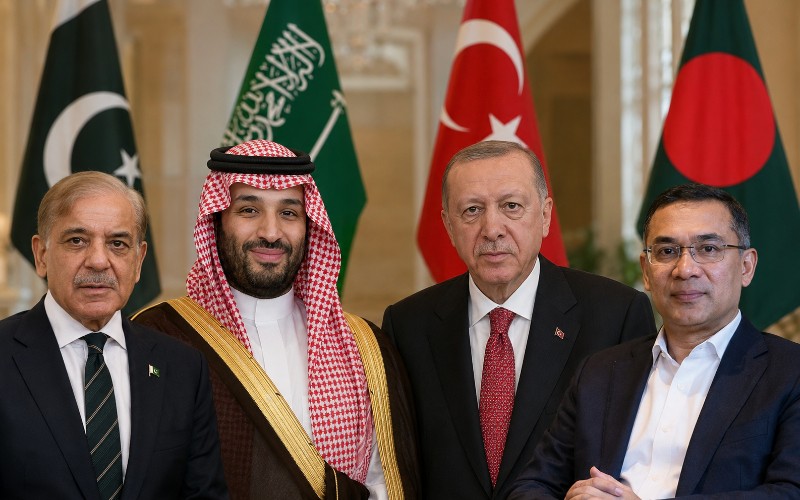
The Mecca Joint Defence Agreement was signed on August 7 by Turkish President Recep Tayyip Erdogan, Pakistani Prime Minister Shehbaz Sharif and Saudi Crown Prince and Prime Minister Mohammed bin Salman.
The first Strategic Political and Defence Committee meeting marks the alliance’s transition from an agreement announced at the political level towards a more structured mechanism for security and defence cooperation.
The Istanbul meeting is expected to examine how the three countries can coordinate their armed forces, strengthen military capabilities and improve interoperability.
Defence-industrial cooperation, including joint production and development, is also expected to feature prominently.
According to Turkish state broadcaster TRT, the three countries are also expected to discuss a permanent secretariat and a roadmap for the alliance’s future activities.
BBC Urdu, citing Turkish Foreign Ministry sources, reported that the meeting would also consider whether new countries should join the framework.
That possibility gives the Istanbul discussions wider significance, although the immediate priority appears to be establishing the alliance’s basic institutional and military mechanisms.
Egypt emerges as the first expansion possibility
While Bangladesh could eventually figure in discussions about expanding the Mecca Pact, Egypt appears to be the more immediate candidate under consideration.
Egypt already works with Turkey, Pakistan and Saudi Arabia through the Regional-4, or R-4, grouping.
The four-country mechanism emerged in March and has focused on regional security issues, including diplomatic efforts linked to tensions between the United States and Iran.
Pakistan Deputy Prime Minister and Foreign Minister Ishaq Dar was also expected to attend a possible R-4 meeting during his current visit to Turkey, according to Dawn.
Turkey has indicated an interest in bringing Egypt into the wider Mecca security framework.
Turkish Foreign Minister Hakan Fidan has previously expressed support for Egypt joining the arrangement.
Egypt’s regional influence and its existing engagement with all three founding members give it a distinct position in discussions over possible expansion.
Where does Bangladesh stand?
Bangladesh is not currently part of the formal Mecca Pact structure, and there is no indication that Dhaka is on the immediate agenda for membership.
Its potential relevance stems from its position as a major Muslim-majority country in South Asia, along with its longstanding relations with Saudi Arabia and Turkey and its interest in regional economic and security cooperation.
However, the Istanbul meeting is primarily expected to concentrate on making the three-member mechanism operational.
Before expansion becomes a central issue, Pakistan, Saudi Arabia and Turkey will need to establish the alliance’s decision-making procedures, military coordination mechanisms and collective-defence arrangements.
The three countries will also have to determine how intelligence-sharing, logistics, training and defence-industrial cooperation will operate within the framework.
The outcome could eventually determine whether the Mecca Pact remains a closely coordinated trilateral arrangement or develops into a broader security framework involving additional Muslim-majority countries.
Senior political and military officials to attend
The first committee meeting is bringing together senior political and military figures from the three founding states.
Turkey is represented by Foreign Minister Hakan Fidan, Defence Minister Yaar Guler and Chief of General Staff General Selcuk Bayraktaroglu.
Pakistan’s delegation includes Chief of Defence Forces Field Marshal Syed Asim Munir, Deputy Prime Minister and Foreign Minister Ishaq Dar and Defence Minister Khawaja Muhammad Asif.
Saudi Arabia is represented by Foreign Minister Prince Faisal bin Farhan Al Saud, Defence Minister Prince Khalid bin Salman bin Abdulaziz Al Saud and Chief of General Staff General Fayyad bin Hamid Al Ruwaili.
Pakistan’s Inter-Services Public Relations separately confirmed that Asim Munir was in Turkey on an "official visit", according to Dawn.
Turkish authorities and state media have also confirmed the gathering of ministers and senior officials from the three countries.
Defence industry cooperation at the centre
Defence cooperation is expected to form the core of the Istanbul discussions.
According to AFP, the participants are expected to discuss strengthening defence capabilities, improving interoperability between their armed forces and expanding defence-industry cooperation.
Reuters has reported that "international security issues" will also be discussed, alongside enhanced military capabilities, interoperability and defence-industrial cooperation, including joint production and development.
The three founding countries bring different capabilities to the proposed framework.
Turkey has developed a substantial indigenous defence industry, Pakistan has extensive military and defence-production experience, while Saudi Arabia has been expanding efforts to develop its domestic defence-industrial base.
Greater coordination could consequently extend into joint research, technology development, manufacturing, military training, logistics and intelligence cooperation.
Gaza, Iran and Red Sea security on the agenda
The committee is meeting against a backdrop of continuing instability across West Asia.
BBC Urdu reported that the broader international security environment is expected to be among the key issues discussed by the three countries.
The security situation surrounding Iran, including unresolved issues involving the Strait of Hormuz and the possibility of renewed tensions, is expected to feature in the talks.
The security of maritime routes in the Red Sea is another major concern, particularly amid attacks by Yemen’s Houthi movement.
Turkey and Pakistan are expected to play constructive roles in Saudi-led efforts relating to Red Sea security, according to BBC Urdu, which cited Turkish Foreign Office sources.
The meeting is also expected to cover Israel’s regional policies and issues surrounding implementation of the second phase of the Gaza peace agreement.
Permanent secretariat could give pact a formal structure
Beyond immediate security concerns, the creation of a permanent institutional structure could prove central to the alliance’s development.
TRT reported that the committee is expected to establish a framework for a permanent secretariat and set out the next steps for the alliance.
BBC Urdu reported that the permanent secretariat is expected to be based in Saudi Arabia and would monitor and implement decisions adopted by the Strategic Political and Defence Committee.
The three countries could also discuss a constitution for the alliance, its working procedures, the frequency of committee meetings and arrangements for future meetings of the leaders.
The framework is expected to emphasise security, peace and stability while promoting a "cooperative security" approach to regional disputes.
Expansion question remains open
The Istanbul meeting is therefore likely to establish the foundations of the Mecca Pact before any significant expansion takes place.
The reported discussion on admitting new members could provide an early indication of the alliance’s longer-term ambitions, but Egypt currently appears more directly positioned for consideration because of its existing involvement in the R-4 mechanism.
For Bangladesh, the significance of the meeting lies less in an immediate membership decision and more in how the alliance defines its future scope.
The institutional architecture, defence cooperation mechanisms and expansion criteria agreed by the founding members could determine whether the Mecca Pact eventually develops into a wider regional security grouping.
Support Our Journalism
We cannot do without you.. your contribution supports unbiased journalism
IBNS is not driven by any ism- not wokeism, not racism, not skewed secularism, not hyper right-wing or left liberal ideals, nor by any hardline religious beliefs or hyper nationalism. We want to serve you good old objective news, as they are. We do not judge or preach. We let people decide for themselves. We only try to present factual and well-sourced news.
Support objective journalism for a small contribution.


